Every kitchen has them—those odd little pockets of space that don’t fit neatly into “counter,” “cabinet,” or “drawer.”
The inside of a cabinet door. The narrow gap beside the refrigerator. That empty space above the cabinets. A blank wall that isn’t quite big enough for another piece of furniture.
These areas are easy to overlook because they don’t immediately look like storage. But with the right approach, some can become surprisingly useful.
Before buying another cabinet, cart, or organizer, take a closer look at the space you already have.
Here are seven awkward kitchen spaces that might be worth putting to work.
Before You Start: Measure the Space
Awkward spaces are especially unforgiving when it comes to measurements.
An organizer that’s half an inch too wide isn’t almost useful. It simply doesn’t fit.
Before buying anything, measure the:
- Width
- Depth
- Height
Then check anything that could interfere with the new storage, including cabinet and appliance doors, drawers, hinges, handles, outlets, plumbing, walkways, and appliance clearance requirements.
Nook & Noted Tip: Measure an awkward space in more than one spot. Walls, cabinets, floors, and appliances aren’t always perfectly square, and the narrowest measurement is often the one that matters.
Once you’ve done that, it’s time to start looking for space you may not have realized you had.
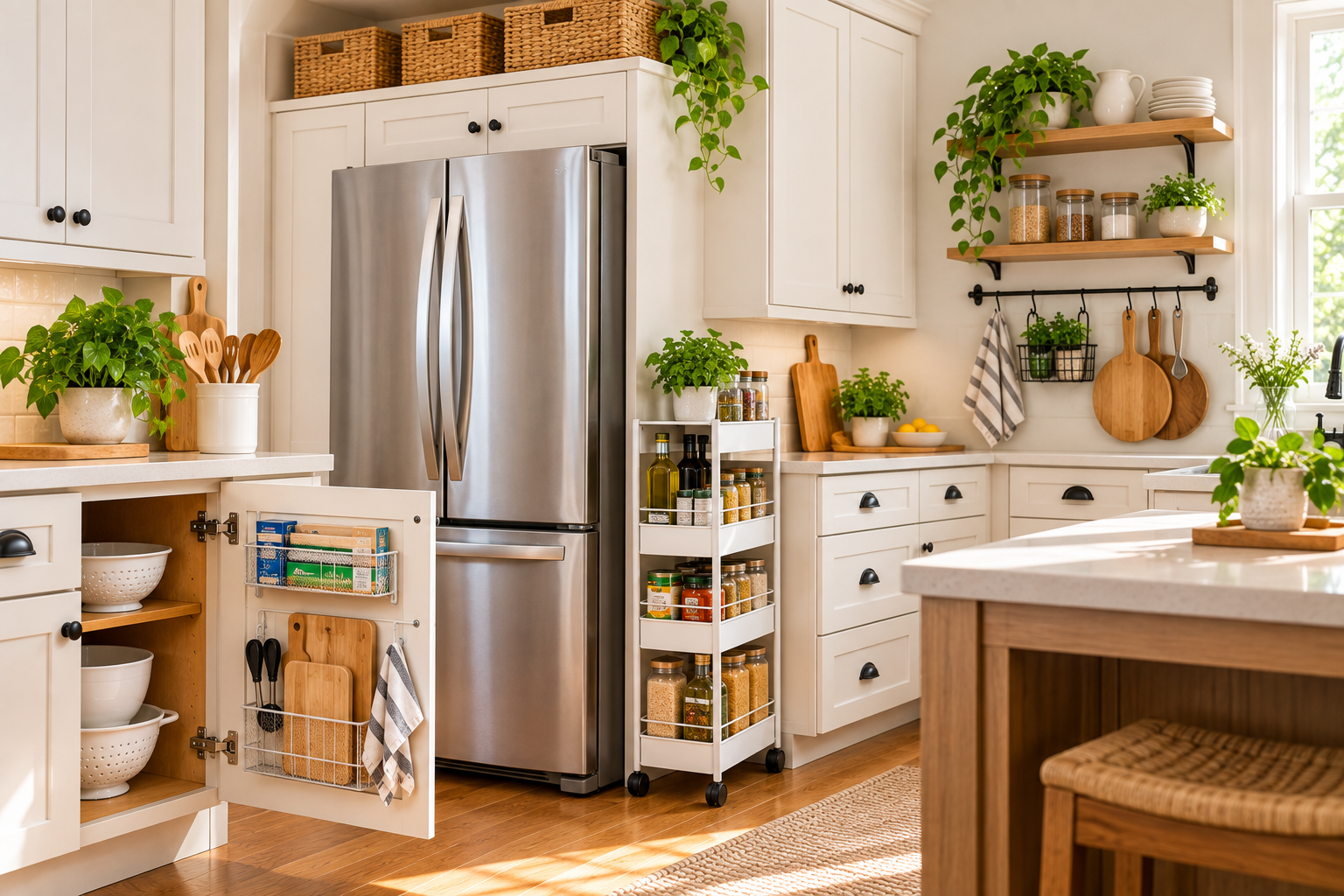
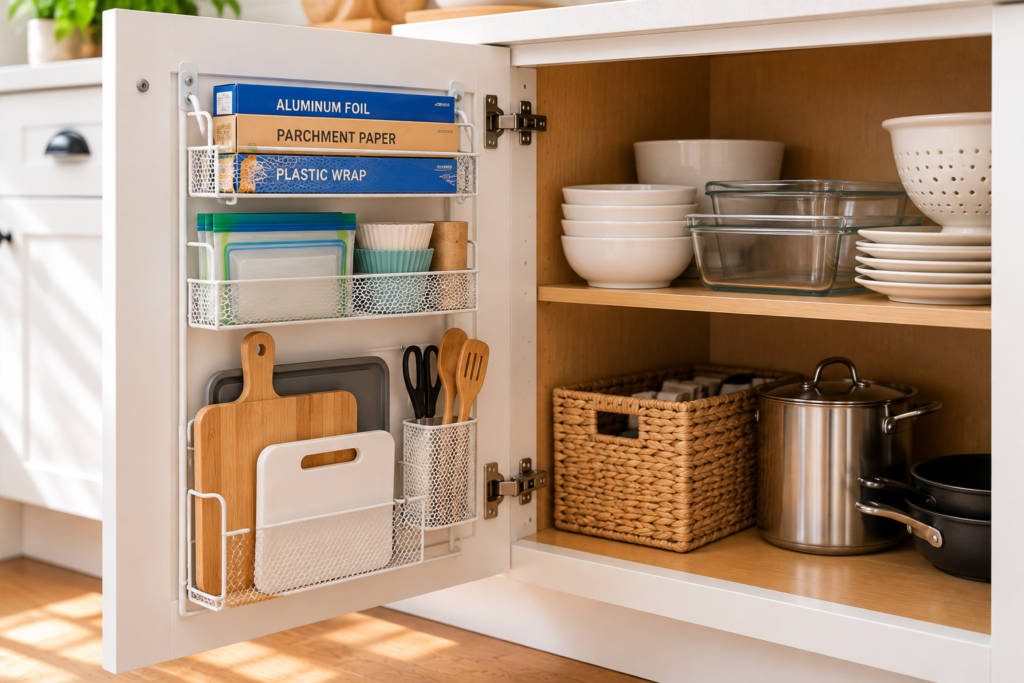
1. Put the Inside of Cabinet Doors to Work
The overlooked space: The back of a cabinet door.
It’s hidden when the cabinet is closed, doesn’t take up any additional floor space, and can be particularly useful for small or relatively flat kitchen items.
Depending on the cabinet, a slim door-mounted organizer could hold:
- Foil and food-storage wrap
- Pot lids
- Lightweight cutting boards
- Measuring spoons
- Small kitchen tools
- Lightweight packets or supplies
The key word here is slim.
There’s usually less usable space behind a cabinet door than it appears when the cabinet is standing open. Shelves, hinges, and the items already stored inside can all get in the way.
Try This Before You Buy
Use painter’s tape to mark the dimensions of the proposed organizer on the inside of the cabinet door.
Then slowly close the door.
You’ll quickly see whether the organizer is likely to hit a shelf or anything stored inside the cabinet.
Also consider the weight you’re adding. A small organizer holding foil and parchment paper puts very different demands on a cabinet door than one filled with heavy cutting boards or cookware.
The goal is to take advantage of unused space without making the cabinet harder to use.
2. Turn an Exposed Cabinet End Into a Mini Storage Wall
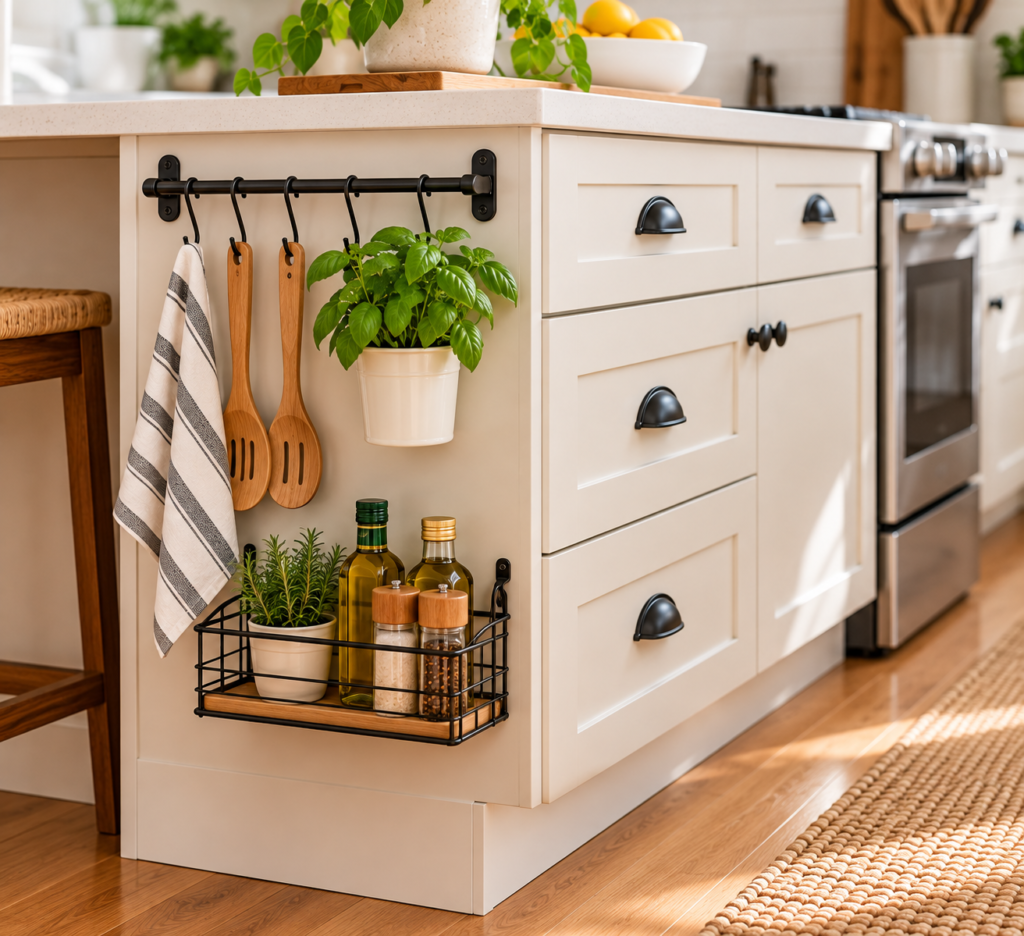
The overlooked space: The exposed side of an end cabinet.
If one side of your cabinetry faces an open area, you may have a perfectly usable vertical surface doing nothing.
Depending on where it’s located, you could use it for:
- A paper-towel holder
- A small rail with hooks
- Oven mitts
- Kitchen towels
- A lightweight basket
- A shallow spice shelf
- Frequently used lightweight tools
This can work especially well when the cabinet is near your main prep area.
A towel, oven mitt, or frequently used utensil stored within arm’s reach can be more useful than another decorative item on the counter.
Watch the Walkway
Keep cabinet-side storage relatively shallow.
If the cabinet faces a busy walkway, anything that sticks out too far can quickly become something everyone bumps into.
Also choose a mounting method that’s appropriate for both the cabinet material and the weight you plan to store.
Nook & Noted Tip: Think about where you’re adding storage, not just whether it fits. The best location is one that makes the item stored there easier to use.
3. Use the Space Above the Refrigerator Wisely
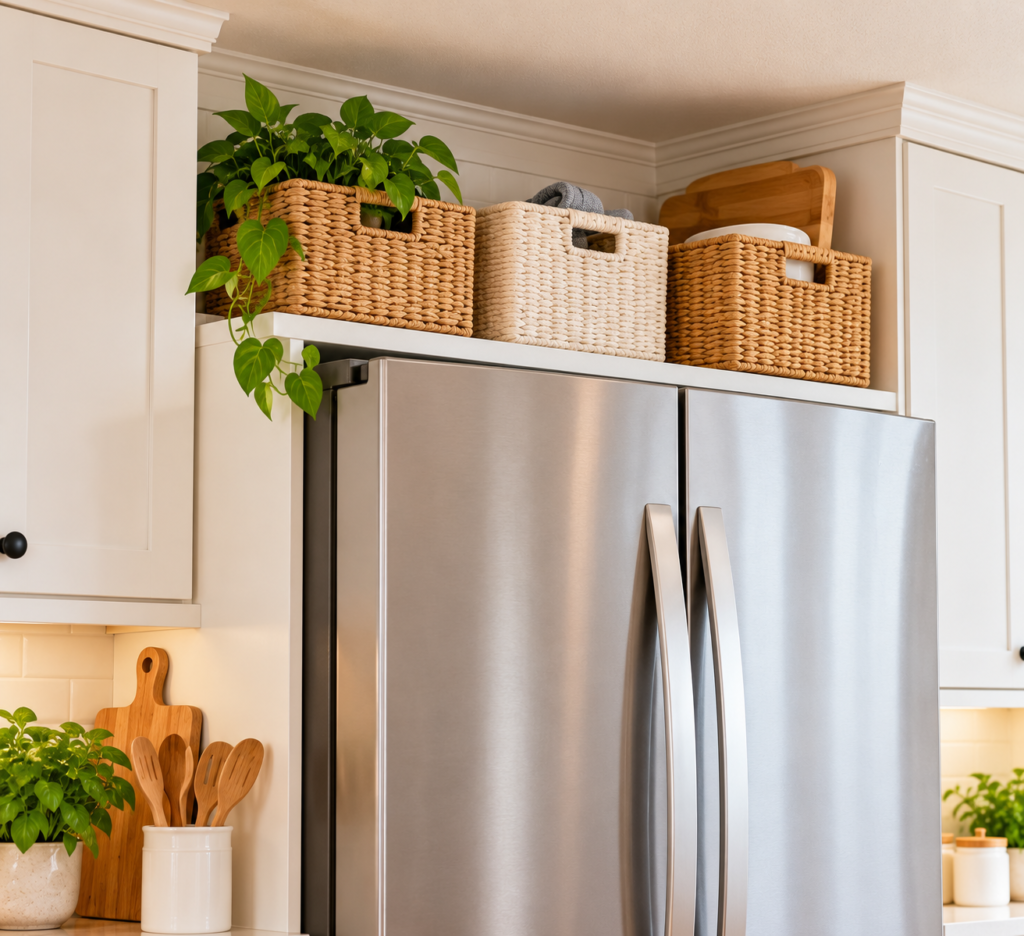
The overlooked space: That awkward area above the refrigerator that’s too high for everyday storage but too useful to automatically ignore.
Because it isn’t particularly convenient to reach, this space is usually better for lightweight things you don’t need very often.
Depending on your kitchen, that might include:
- Seasonal table linens
- Lightweight serving trays
- Extra paper goods
- Party supplies
- Lightweight baskets
- Rarely used kitchen accessories
Baskets or handled containers can help keep smaller items together and make the space look intentional rather than forgotten.
Keep It Lightweight
This isn’t the place for a heavy appliance you have to wrestle down from overhead.
Choose lightweight items and containers that are easy to grip securely.
Before storing anything above or around a refrigerator, check the manufacturer’s clearance and ventilation requirements. Don’t fill space the appliance needs for safe and proper operation.
And if you can’t comfortably reach the area, use an appropriate stable step stool rather than climbing onto a chair or countertop.
Nook & Noted Tip: High storage works best when the inconvenience of reaching it matches how rarely you need what’s stored there.
4. Make Use of Narrow Gaps Between Cabinets and Appliances
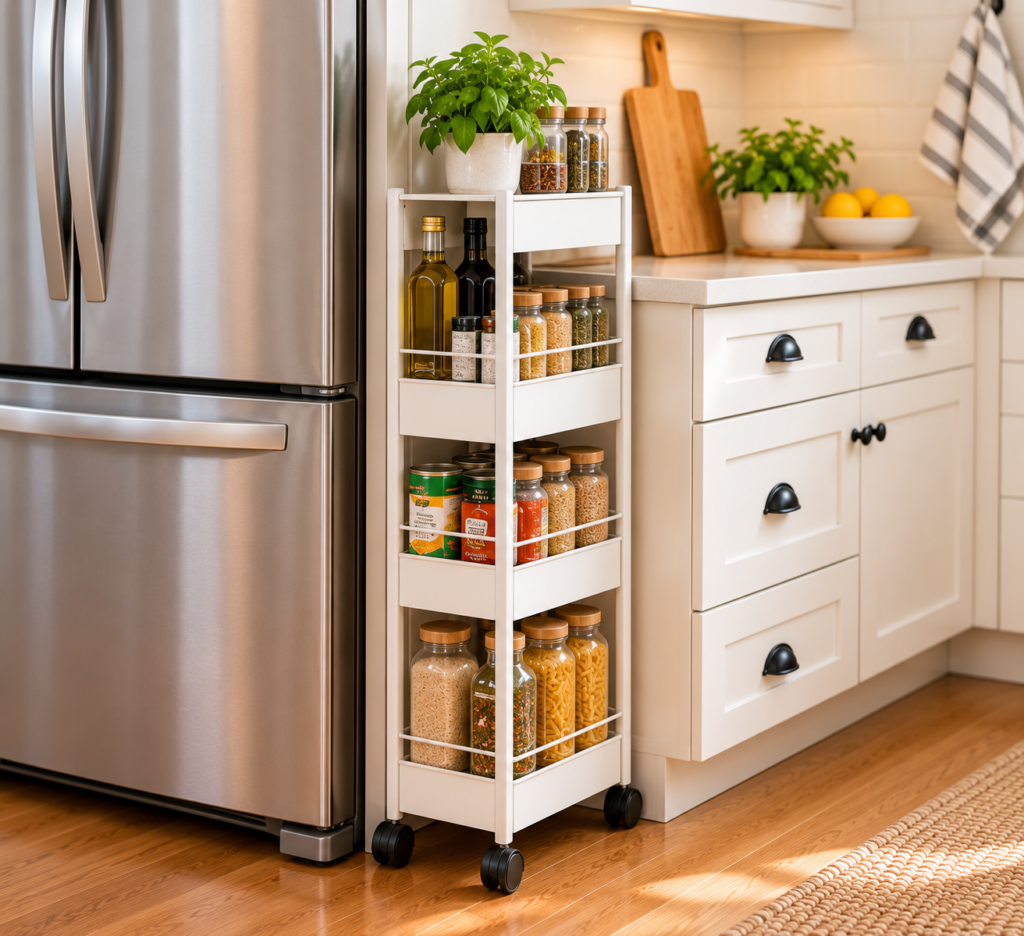
The overlooked space: That strange sliver beside the refrigerator, between a cabinet and a wall, or in another narrow part of the kitchen.
A gap that looks useless may be just wide enough for a slim rolling cart or another appropriately sized narrow organizer.
Depending on the location, it could potentially hold:
- Bottles
- Pantry staples
- Baking supplies
- Canned goods
- Kitchen linens
- Cutting boards or baking sheets
A rolling design can be especially useful because you can pull the entire organizer into view instead of reaching into a deep, narrow space.
Measure This One Carefully
Measure the width near the floor, middle, and top of the opening.
Don’t assume all three measurements will be identical.
And don’t shop for a rolling cart based only on its advertised shelf width. Check the complete dimensions, including wheels, handles, rails, or other pieces that may extend beyond the main frame.
The organizer also needs enough clearance to move freely.
If the gap is beside an appliance, make sure nothing interferes with ventilation, electrical connections, water lines, door swing, or manufacturer-required clearances.
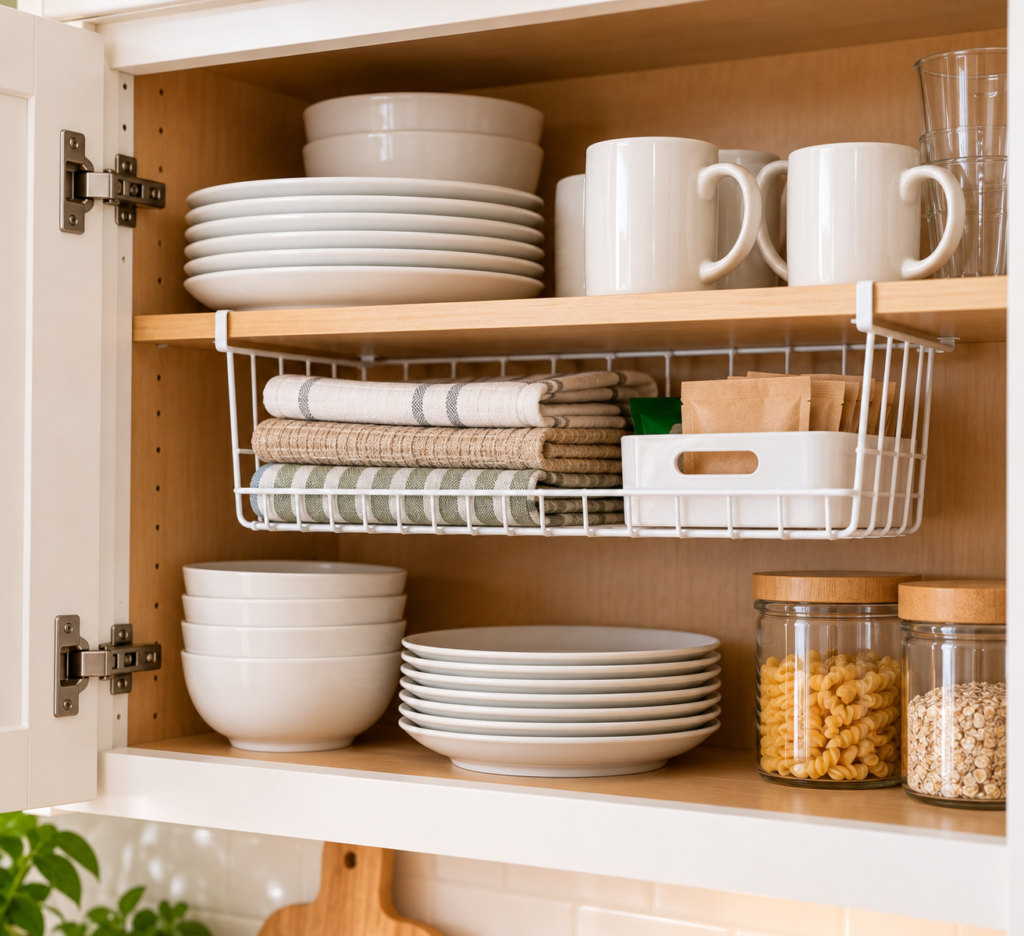
5. Use the Empty Space Under Cabinet Shelves
The overlooked space: The air between the bottom of a shelf and the items stored beneath it.
Kitchen cabinets are often designed with enough vertical space for tall items. When you’re storing shorter dishes or supplies, that can leave a surprising amount of empty space above them.
An under-shelf basket or another appropriately designed organizer can sometimes create a second storage level without permanently adding another shelf.
This can work well for lightweight items such as:
- Napkins
- Kitchen linens
- Small packets
- Food-storage supplies
- Lightweight kitchen accessories
Don’t Hang It Too Low
Before choosing an organizer, measure both the thickness of the cabinet shelf and the amount of open space underneath it.
Make sure the basket doesn’t hang so low that accessing the items below becomes more difficult.
Also pay attention to its intended weight capacity.
Nook & Noted Tip: Under-shelf storage works best when it fills genuinely unused vertical space. If you’re squeezing another layer into an already crowded cabinet, it may create more frustration than storage.
6. Don’t Ignore the Space Above Upper Cabinets
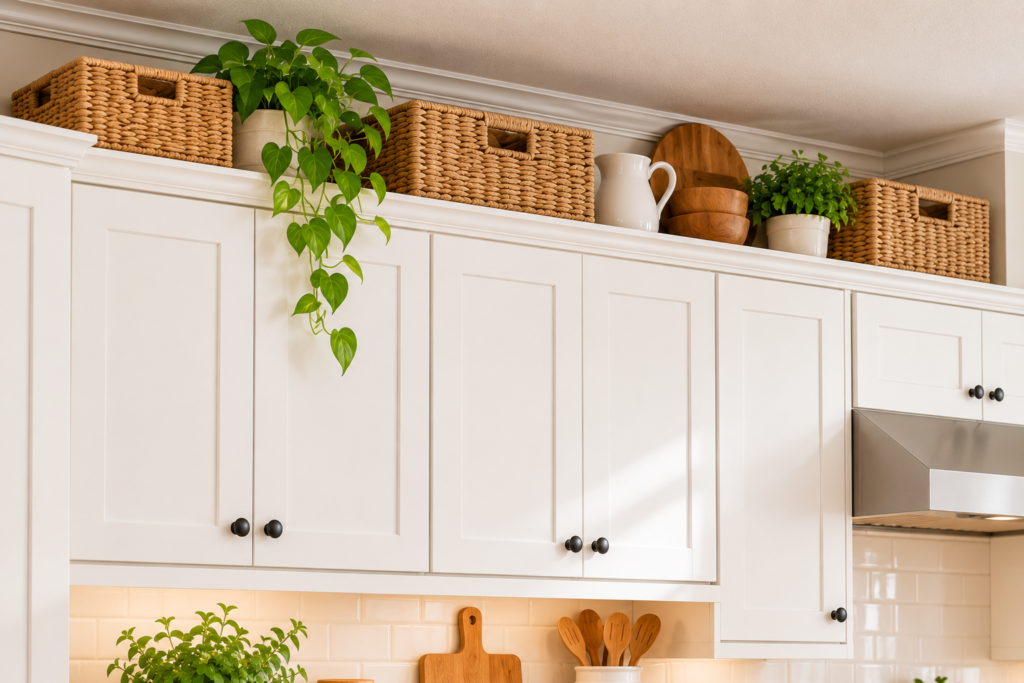
The overlooked space: The gap between your upper cabinets and the ceiling.
If your cabinets don’t extend all the way up, that horizontal space may be useful for a few lightweight, infrequently used items.
The important word is few.
Filling the entire area with unrelated objects can quickly make a kitchen feel more cluttered rather than more organized.
Instead, consider a small number of coordinating baskets or containers for things such as:
- Seasonal table linens
- Party supplies
- Specialty serving pieces
- Extra lightweight supplies
- Rarely used kitchen accessories
Keep High Storage Simple
A few larger containers usually look calmer than a long row of unrelated objects.
Choose lightweight containers that are easy to grip securely. Handles can be especially helpful when you’re retrieving something from overhead.
Keep in mind that anything stored above kitchen cabinets can collect dust and cooking residue. Washable or easy-to-wipe containers may be more practical than open baskets in some kitchens.
And avoid storing heavy or difficult-to-handle items overhead.
Nook & Noted Tip: Don’t let high storage become a place to postpone decluttering. If something has been sitting above the cabinets untouched for five years, ask whether you still need it before finding a prettier basket for it.
7. Turn a Blank Wall Into Flexible Kitchen Storage
The overlooked space: A stretch of wall that isn’t large enough for another cabinet but could still be useful.
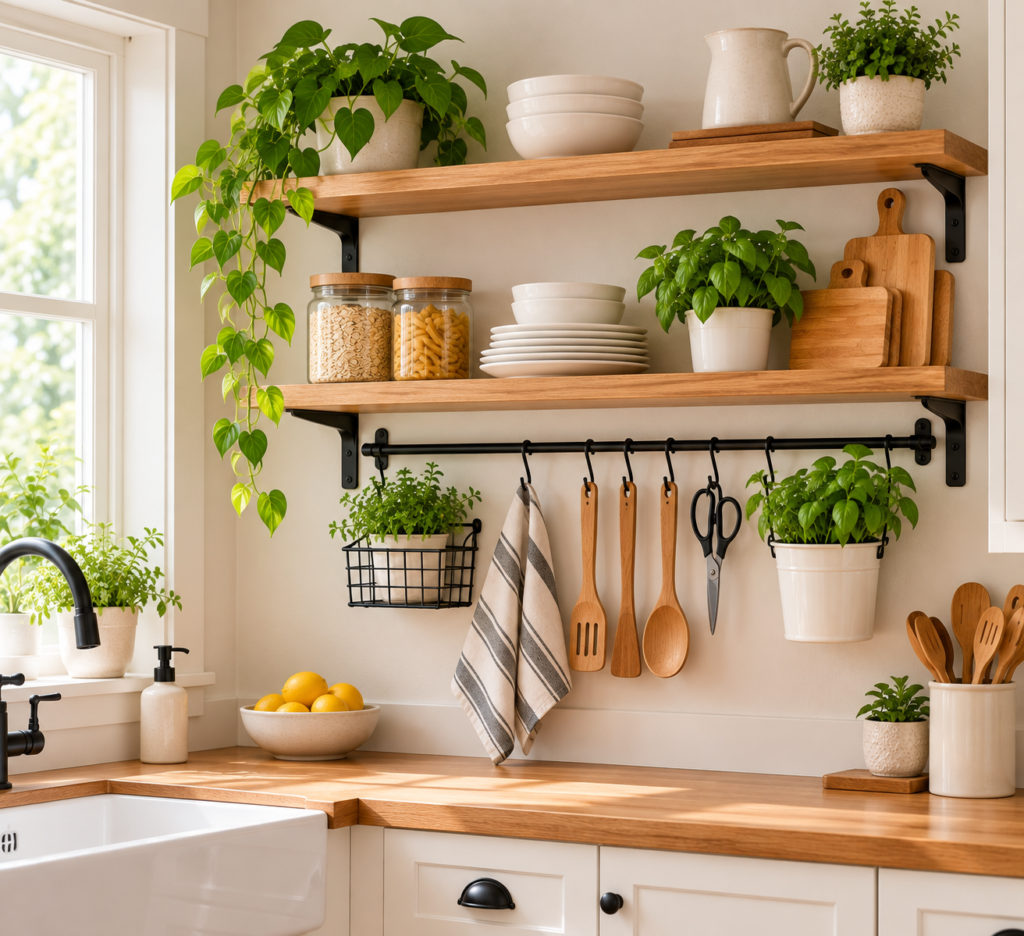
Wall-mounted storage can be particularly valuable in a small kitchen because it adds function without taking up additional floor space.
Depending on the location, consider:
- A pegboard
- A rail-and-hook system
- Floating shelves
- A small wall-mounted rack
- Hanging baskets
- Utensil storage
Flexible systems such as rails and pegboards can be especially useful because you can rearrange them as your storage needs change.
Start With What You Need to Store
Don’t begin with an empty wall and ask:
How much storage can I fit here?
Start with:
What do I need a better place for?
If it’s three frequently used utensils and a kitchen towel, a small rail may solve the problem.
If it’s mugs or a few everyday dishes, a properly installed shelf might make more sense.
Choose a system and mounting method appropriate for the weight you plan to store and the construction of the wall.
Also consider the location. Keep wall storage clear of places where heat, moisture, door movement, or heavy traffic could make it inconvenient.
Nook & Noted Tip: Don’t fill an entire wall simply because it’s empty. Start with the smallest amount of storage that solves the problem.
Not Every Empty Space Needs to Become Storage
Once you start looking for unused kitchen space, it’s tempting to turn every available inch into another shelf, basket, hook, or rack.
But empty space isn’t automatically wasted space.
Sometimes leaving an area open makes the kitchen:
- Easier to clean
- Easier to walk through
- Less visually cluttered
- Safer around appliances
- More comfortable to use
If adding storage makes a walkway tighter, interferes with a cabinet door, blocks appliance ventilation, or forces you to move three things every time you need one, it probably isn’t improving the kitchen.
The goal isn’t to fill every inch. It’s to make the space you have work better.
Before You Buy an Organizer, Measure Twice
Once you’ve found an overlooked space you’d like to use, resist the urge to immediately order something that looks like it will fit.
Take a few minutes to check the space properly.
Your Awkward-Space Checklist
1. Measure the width, depth, and height.
Write the measurements down rather than relying on memory.
2. Measure more than once.
For a narrow gap, check the width at the top, middle, and bottom.
3. Check what moves nearby.
Open cabinet doors, appliance doors, and drawers completely.
4. Look for hidden obstacles.
Check hinges, handles, baseboards, outlets, pipes, water lines, and anything else that could reduce the usable space.
5. Consider the walkway.
An organizer that technically fits may still stick out too far for a comfortable path through the kitchen.
6. Think about what you’re actually storing.
The organizer should solve a storage problem you already have—not create a reason to accumulate more things.
A simple solution that fits perfectly is far more useful than an elaborate organizer that almost works.
Awkward Kitchen Storage FAQs
How do I find unused storage space in a small kitchen?
Look beyond traditional cabinets and drawers.
Check the inside of cabinet doors, exposed cabinet ends, narrow gaps beside appliances, unused vertical space inside cabinets, blank walls, and higher spaces you may normally ignore.
Then ask whether one of those areas could solve a storage problem you already have.
You don’t need to turn every empty spot into storage. Concentrate on the spaces that would actually make your kitchen easier to use.
What can I store above kitchen cabinets?
The space above kitchen cabinets is best suited to lightweight items you use infrequently, such as seasonal linens, party supplies, lightweight serving pieces, or extra kitchen supplies.
A few coordinating containers can help the area look intentional rather than cluttered.
Avoid storing heavy or difficult-to-handle objects overhead, and remember that containers stored near cooking areas may need regular cleaning.
What can I put in the narrow gap beside my refrigerator?
Depending on the width of the gap and the refrigerator’s required clearances, a slim rolling cart may provide storage for pantry staples, canned goods, bottles, baking supplies, or other kitchen essentials.
Before adding anything beside an appliance, check its ventilation and clearance requirements and make sure the organizer won’t interfere with doors, electrical connections, water lines, or other components.
How can I add kitchen storage without remodeling?
Start by making better use of the storage surfaces you already have.
Cabinet-door organizers, freestanding shelf risers, under-shelf baskets, rolling carts, and certain wall-storage solutions can create additional usable space without adding cabinetry or changing the kitchen layout.
The Bottom Line
Some of the best kitchen storage isn’t found in a bigger pantry or another cabinet.
It’s hiding in the spaces you already have but don’t normally think to use.
A narrow gap might fit a rolling organizer. The back of a cabinet door could hold food-storage supplies. An exposed cabinet end could become a small storage wall. A blank wall might support a few frequently used kitchen essentials.
You don’t need to use all seven ideas.
Take one slow walk around your kitchen and look specifically at the places you normally ignore.
Then ask one simple question:
Could this space solve a storage problem I already have?
If the answer is yes, measure it carefully and find the simplest solution that makes sense.
If the answer is no, leave it alone.
You may already have some of the storage space you need.
It just doesn’t look like storage yet.