Bathroom drawers are small, but they carry a lot of responsibility.
Between hair ties, lip balm, tweezers, dental floss, and that travel-size lotion from a trip you barely remember, they can turn into a jumble faster than almost any other spot in the house.
And somehow, the one thing you need always seems to be hiding underneath everything else.
The good news? Bathroom drawers are one of the easiest places to get organized. They’re small, contained, and usually don’t require expensive products or a complete makeover.
A few practical changes can make your everyday essentials easier to find and your morning routine noticeably smoother.
Here are seven bathroom drawer organization ideas that actually work, even when you’re dealing with limited space.
Before You Organize, Empty the Drawer Completely
It’s tempting to drop a few organizers into a messy drawer and call it a day. But the most helpful first step is usually the simplest: take everything out.
Wipe down the inside of the drawer, then look at what you’ve been storing.
You might discover three nearly identical lip balms, a collection of stretched-out hair ties, or several products you haven’t touched in months.
Sort everything into three groups:
- Everyday essentials: Things you use daily or several times a week
- Occasional-use items: Products you need sometimes but don’t reach for regularly
- Things that belong elsewhere: Backups, travel toiletries, or items that don’t need to take up valuable drawer space
Throw away empty packaging, broken accessories, and products that are expired or no longer safe to use. Check product labels for disposal instructions when needed.
Keep unopened backups together in another suitable storage spot rather than crowding your everyday drawer.
Once you know what’s actually going back in, it’s much easier to choose an organization system that fits.
Nook & Noted Tip: If you find three nearly identical products, keep the one you’re using and move unopened backups somewhere else. Less crowding makes everything easier to find.
1. Measure First, Then Choose Your Organizer
The problem: You buy a drawer organizer that looks perfect online, only to discover it’s too wide, too tall, or leaves awkward gaps.
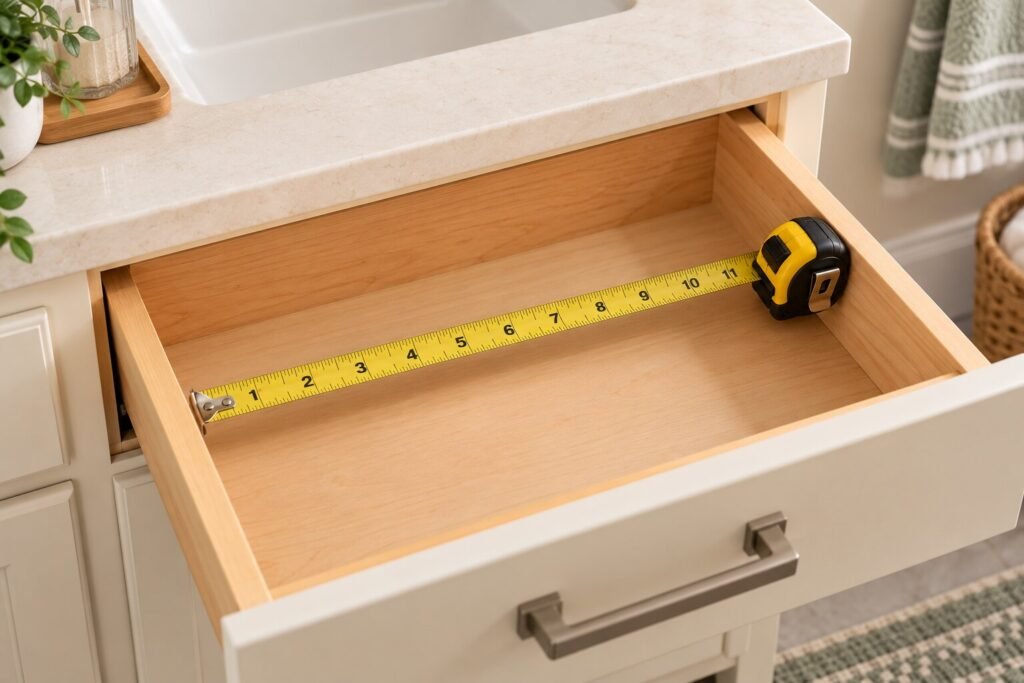
The fix: Measure the inside of your bathroom drawer before buying anything.
Check the width, depth, and height, including any plumbing cutouts, drawer supports, or other features that limit usable space.
Pay particular attention to height. An organizer might fit inside the drawer but still prevent it from closing once you’ve added your products.
Try What You Already Have First
Before shopping, experiment with a few small boxes or containers you already own.
Arrange them inside the empty drawer to see what sizes and shapes work best.
This gives you a better idea of whether you need several small compartments, one larger tray, or a combination of both.
You might even discover that the containers you already have work perfectly well.
Nook & Noted Tip: Don’t forget to measure the drawer’s usable height. Even a shallow tray can be too tall once you add a bottle or grooming tool.
2. Use Small, Adjustable Trays Instead of One Big Insert
The problem: A large, fixed drawer organizer doesn’t quite match the items you need to store.
The fix: Use several smaller trays or adjustable dividers that can be arranged to fit your drawer.
Small compartments make it easier to separate everyday essentials without wasting space.
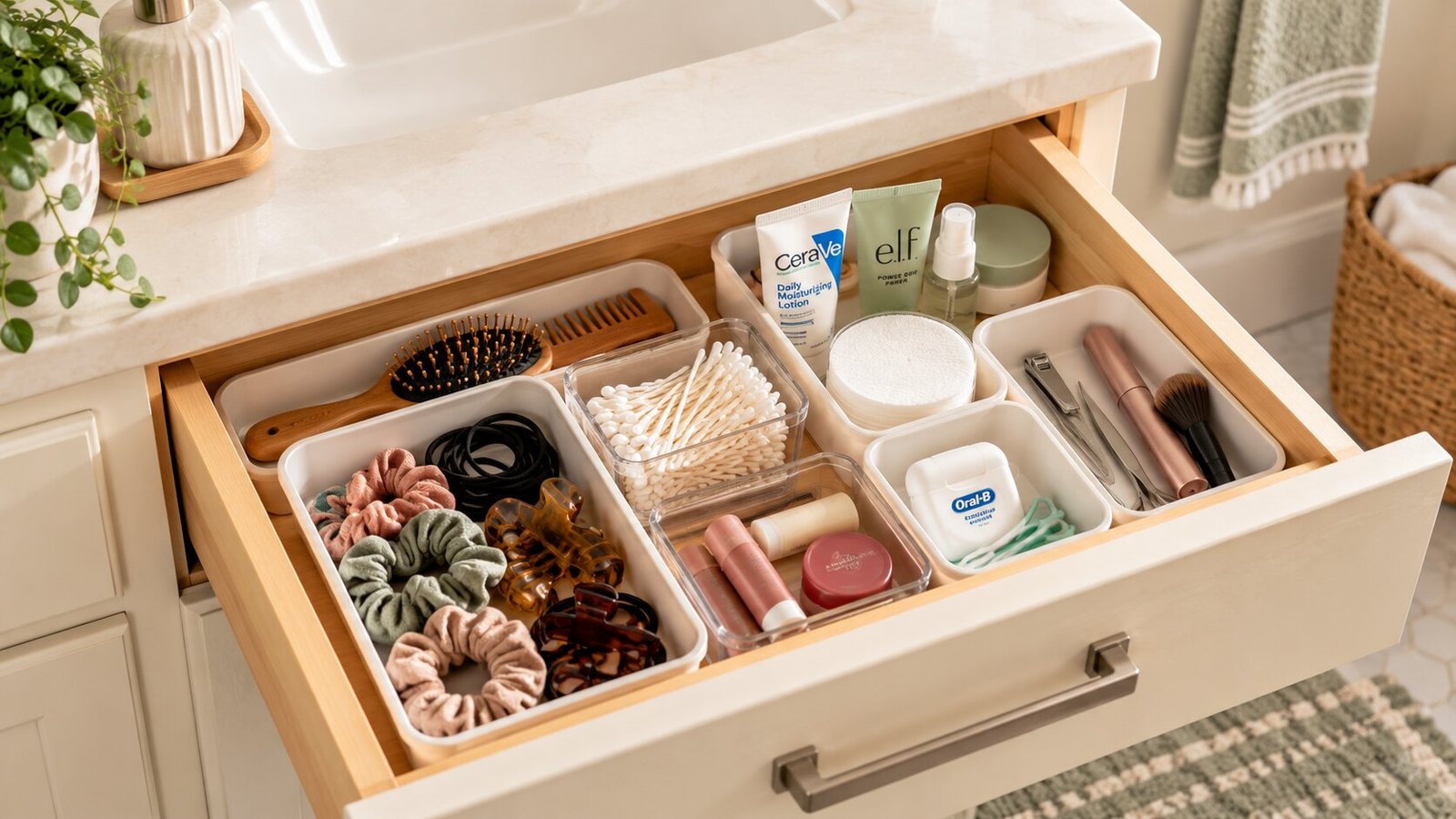
For example, you might use:
- A narrow tray for tweezers and nail clippers
- A small compartment for lip balm
- A wider tray for a hairbrush or comb
- A shallow container for dental floss and other small items
Unlike a single large organizer with fixed sections, smaller trays can be moved around as your routine changes.
Keep the Trays From Sliding
One common frustration with drawer organizers is that they shift every time you open or close the drawer.
Choose trays that fit together snugly, or use a washable nonslip drawer liner to help keep them in place.
And don’t feel obligated to buy a matching set.
Simple plastic trays, small repurposed containers, and inexpensive adjustable dividers can all do the job.
Nook & Noted Tip: Start with only enough compartments for the things you actually use. A drawer filled with organizers can be just as frustrating as a drawer filled with clutter.

3. Group Items by Your Daily Routine
The problem: Everything is neatly separated by category, but you still have to search through several compartments to get ready.
The fix: Organize your bathroom drawer around how you actually use your products.
Instead of focusing only on categories like skincare, hair care, and grooming, think about which items you reach for together.
If your morning routine includes moisturizer, lip balm, and a hairbrush, keeping those items close to one another may make more sense than storing them in completely separate areas.
You could create simple groups for:
- Morning skincare essentials
- Hair accessories and grooming tools
- Dental care items
- Evening skincare products
You don’t need a separate compartment for every step. Just keep related items close enough that getting ready feels easier.
What About Shared Bathrooms?
If several people use the same bathroom, consider giving each person a small section of the drawer.
This can prevent everyone’s belongings from getting mixed together and make it easier to put things back.
For very small drawers, a separate small caddy or cabinet shelf for each person may work better.
Nook & Noted Tip: Pay attention to what you reach for first each morning. Those items deserve the easiest-to-access spot.

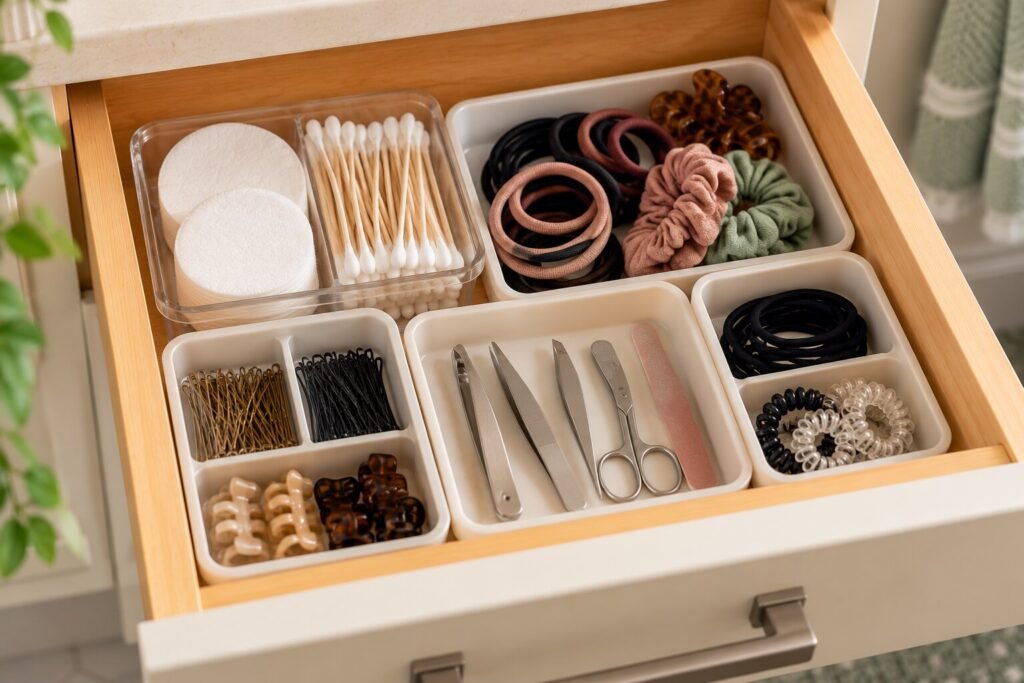
4. Give Tiny Items Their Own Compartments
The problem: Hair ties, bobby pins, cotton swabs, and other small items scatter every time the drawer opens.
The fix: Give small accessories their own contained spaces.
A few shallow compartments can keep hair ties from tangling with bobby pins and prevent tweezers from disappearing underneath larger products.
Small, washable containers work especially well in bathrooms because they’re easy to clean if something spills.
For items that need to stay particularly clean, such as cotton swabs, consider a small covered container.
Small Containers Can Make a Big Difference
You don’t need a special organizer for every little item.
A clean, repurposed container might work for hair ties, while a narrow tray could hold bobby pins and nail clippers.
The important thing is choosing containers that fit securely inside the drawer and are easy to use.
Try to avoid stacking small items on top of one another. If you can see everything at a glance, you’re much less likely to forget what you already have.
Nook & Noted Tip: If tiny items keep escaping their compartments, try a smaller container rather than adding another organizer. Sometimes a better fit is all you need.
5. Give Tubes and Bottles Their Own Space
The problem: Taller products don’t fit upright, and loose tubes roll around whenever you open the drawer.
The fix: Store different types of products according to their shape and how securely they close.
Toothpaste, hand cream, and other securely capped tubes can often lie flat in a narrow drawer compartment.
Keeping them in a single layer with their labels facing up makes it easier to see what you have.
For bottles with pumps, loose caps, or products that may leak, upright storage in a deeper drawer or cabinet is usually a better choice.
Avoid Overstuffing the Drawer
If you have to force the drawer closed, it’s probably holding too much.
Move oversized products and rarely used items to another storage area.
You can also use a small washable tray for products that occasionally drip or leave residue, provided they’re suitable for drawer storage.
The goal is to make everything easy to see and retrieve without having to rearrange the entire drawer.
Nook & Noted Tip: Place tube labels facing up whenever possible. You’ll find what you need without picking up every product to check what it is.

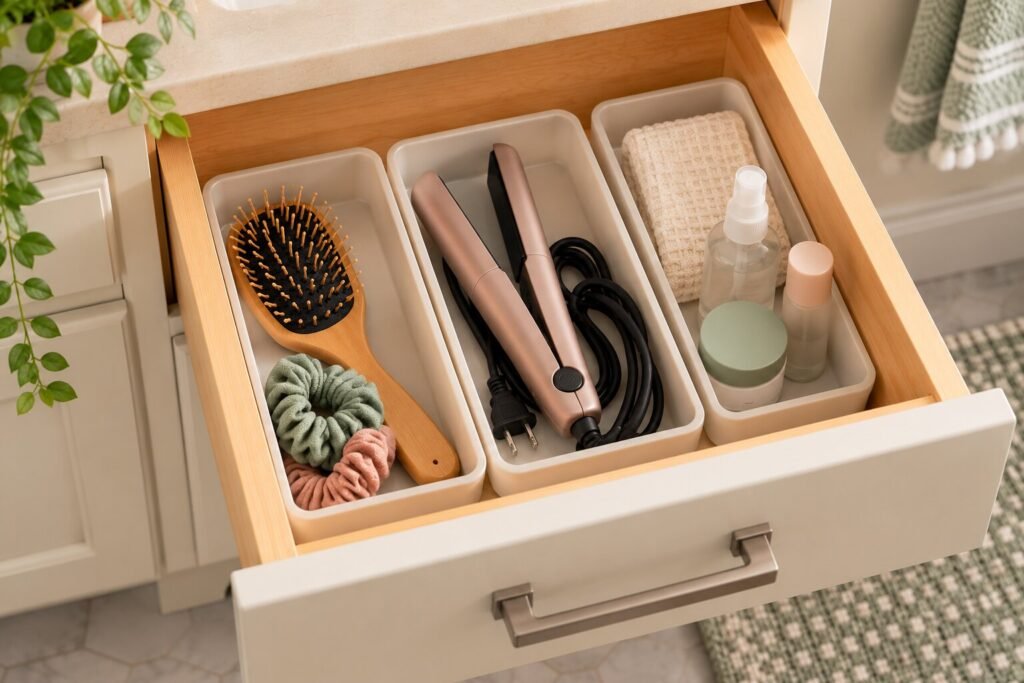
6. Create a Safe Storage Spot for Hair Tools
The problem: Hair straighteners, curling irons, and their cords take up valuable drawer space and create a tangled mess.
The fix: Give styling tools a dedicated storage spot where they won’t become tangled with smaller bathroom essentials.
If you have a deeper vanity drawer, you may be able to store a completely cooled hair straightener or curling iron in its own compartment.
Keep the cord loosely coiled rather than wrapping it tightly around the tool, which can place unnecessary stress on the cable.
Make Safety Part of the System
Always unplug heated styling tools and allow them to cool completely before putting them into a regular drawer or storage container.
Follow the manufacturer’s storage instructions, particularly if using a heat-resistant pouch or holder.
If your bathroom drawers are too shallow, don’t force the tools to fit.
A cabinet shelf or properly installed holder may be a more practical option.
And keep electrical tools away from water and damp storage areas.
Nook & Noted Tip: Sometimes the best drawer organization decision is moving something out of the drawer entirely. Bulky styling tools don’t need to compete with your everyday essentials.
7. Keep Everyday Essentials at the Front of the Drawer
The problem: Products you rarely use take up the easiest-to-reach space, while everyday essentials get pushed toward the back.
The fix: Arrange your drawer according to how often you use each item.
Keep the things you reach for every day near the front, where they’re easy to see and grab.
Items you use only occasionally can go toward the back, while unopened backups and rarely used products can move to another suitable storage spot.
For example:
- Front: Lip balm, dental floss, hair ties, and everyday grooming essentials
- Middle: Products used a few times a week
- Back: Occasional-use items that still belong in the drawer
This simple arrangement can make your morning routine feel much more efficient.
Let Your Habits Guide the Layout
There’s no single perfect arrangement for every bathroom drawer.
What matters is whether the layout works for you.
If you constantly have to move one product to reach another, consider switching their places.
And if something always ends up on the bathroom counter instead of back in the drawer, ask yourself whether its assigned spot is actually convenient.
Nook & Noted Tip: If you have to move something every morning to reach another item, it’s probably time to switch their places.
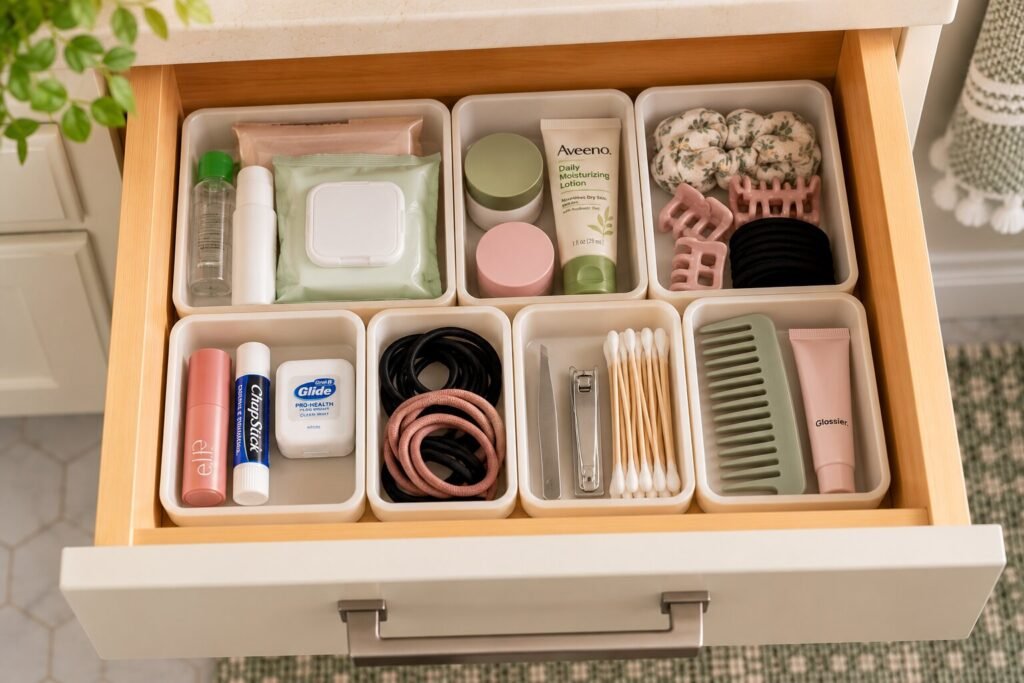
Keep Your Bathroom Drawer Organized With a Two-Minute Reset
Even the best-organized bathroom drawer needs a little attention occasionally.
Fortunately, keeping it tidy doesn’t require emptying everything and starting over.
Once a week, take about two minutes to:
- Return misplaced items to their compartments
- Throw away empty packaging
- Wipe up spills or residue
- Check whether any section is getting overcrowded
- Move unnecessary backups out of the drawer
If one compartment constantly becomes messy, take a closer look at what’s happening.
Maybe it’s too small, maybe it holds too many items, or maybe the products simply belong somewhere more convenient.
Small adjustments are part of finding a system that works.
Nook & Noted Tip: Pair your quick drawer reset with something you already do, like wiping down the bathroom counter or getting ready for the week ahead.
A Bathroom Drawer That Works for You
A well-organized bathroom drawer doesn’t need expensive inserts, matching containers, or a complicated system.
It just needs to make your everyday routine easier.
When the items you use most are easy to reach, small things stay contained, and everything has a sensible place, even a shallow drawer can work surprisingly well.
Start with one drawer. Empty it, sort what you actually use, and try a few simple containers before buying anything new.
Leave a little open space, and give yourself permission to adjust the arrangement as your routine changes.
Sometimes the smallest organizing projects make the biggest difference in how smoothly your day begins.
Looking for More Home Organization Inspiration?
Looking for more ways to make your home feel organized and functional? Explore practical organization ideas, small-space solutions, and clever home finds from Nook & Noted.