Small closets have a way of filling up the moment you stop paying attention. One season’s clothes overlap with the next, shoes multiply, and suddenly you’re wrestling the door closed over a pile of things that don’t technically live there anymore.
The good news is that a small closet usually has more usable space than it looks like at first glance—it’s just not always being used efficiently. A few smart changes can make a tight closet feel significantly roomier, without knocking down a single wall.
Here are nine ways to make more room in a small closet, starting with the space you already have.
Message from Nook and Noted: This post contains affiliate links. We may earn a commission from qualifying purchases.
Before You Organize, Take Everything Out
It’s tempting to organize around what’s already in the closet, but that usually just rearranges the clutter instead of solving it. Pull everything out, sort it into keep, donate, and toss, and only put back what you actually wear or use.
Most small closets aren’t short on space—they’re short on edited space. A closet that’s holding clothes you haven’t worn in two years is already working at a disadvantage before a single organizer gets involved.
Nook & Noted Tip: You can’t organize your way out of a closet that’s holding too much. Edit first, organize second.
Measure the Empty Closet
Before buying organizers, take a few basic measurements. Check the closet’s width and depth, shelf dimensions, door clearance, and the open space beneath shorter hanging clothes.
Small closets don’t leave much room for organizers that are an inch or two too large, so knowing your measurements before you shop can save you from buying something that doesn’t actually fit.

Look for the Dead Space
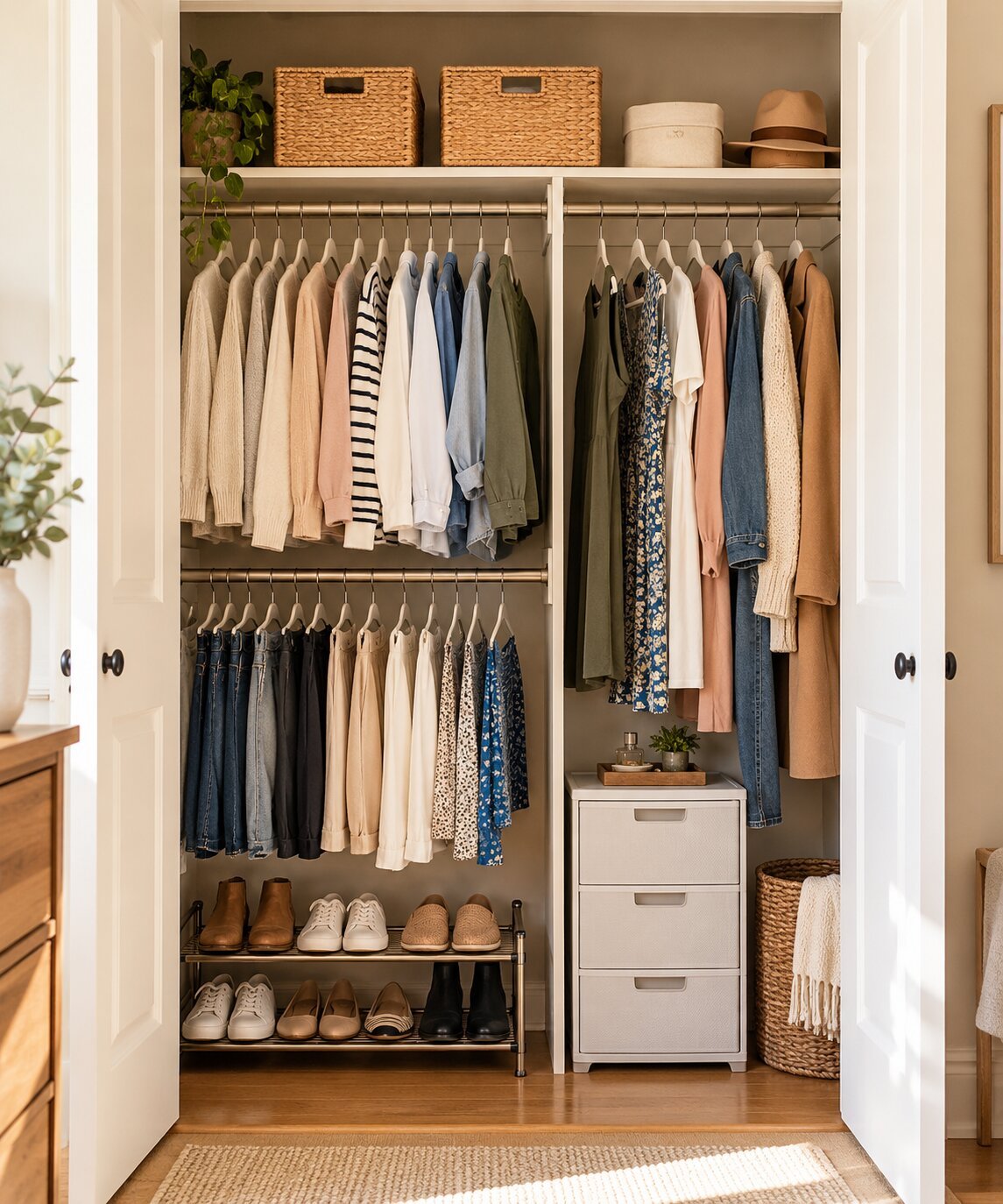
Once the closet is empty, look for the spaces that aren’t doing anything: the gap beneath short hanging clothes, empty space above the rod, the back of the door, or unused height between shelves.
Those overlooked areas are often the easiest places to gain storage without making the closet feel more crowded.
1. Add a Second Hanging Rod
Many closets are designed with a single rod at a height meant to accommodate long garments—even though shirts, skirts, and folded-over pants don’t need nearly that much vertical space.
If most of your wardrobe consists of shorter hanging items, adding a second rod underneath the first can dramatically increase the amount of clothing you can hang in the same footprint.
Measure Before You Mount
Check the length of your shortest hanging items before installing the second rod, and leave enough room so clothing doesn’t bunch together or drag on the closet floor.
If you have dresses, coats, or other long garments, keep part of the closet as a single-hanging section instead of installing a second rod across the entire width.
Nook & Noted Tip: Double hanging works best when you divide the closet according to what you actually own rather than trying to make every section identical.

Like this space-saving solution? Try STORAGE MANIAC’s Adjustable Width and Height Hanging Closet Rods.
2. Use Slim, Matching Hangers
Bulky hangers take up more rod space than you might think, and a mismatched collection can make a closet look more chaotic than it actually is.
Switching to slim, uniform hangers can create a little extra breathing room on a crowded rod while instantly making the closet look tidier.
Consistency Makes a Difference
You don’t need expensive hangers. Using one basic style creates a cleaner visual line and helps clothing sit more evenly along the rod.
If you’re replacing hangers gradually, start with the most crowded section of the closet rather than feeling like you need to replace everything at once.
Nook & Noted Tip: Slim hangers won’t solve an overstuffed closet, but they’re an easy finishing touch once you’ve edited what you own.
3. Use the Space Above the Rod
The upper part of a closet often becomes wasted space simply because it’s inconvenient to reach. If you have enough vertical room, an additional shelf—or better use of an existing one—can create valuable storage for things you don’t need every day.
Off-season clothing, extra linens, handbags, or less frequently used accessories are all good candidates.
Store by Frequency
Keep everyday items within easy reach and let the higher shelves hold things you only need occasionally.
Handled or open-top bins can make higher shelves much easier to use because you can pull down an entire category instead of reaching around for individual items.
Choose bins that fit the depth of the shelf rather than buying oversized containers that leave wasted space behind them or turn into catch-alls.
Nook & Noted Tip: High shelves are best for low-frequency items. If you’re climbing up there every few days, that item probably needs a more convenient home.

4. Use the Back of the Closet Door
The inside of a closet door is one of the most overlooked storage spots in the room.
A hanging organizer, a few hooks, or a slim shoe organizer can hold shoes, bags, scarves, belts, or accessories without using valuable floor or shelf space.
Check the Clearance First
Before adding anything to the door, check how far your hanging clothes extend toward it when the closet is full.
A deep organizer isn’t much help if you have to shove the door closed every time you use it.
Nook & Noted Tip: Door storage works especially well for smaller things you reach for frequently but don’t want taking up prime shelf space.

Like this idea? Check out Amazon’s Choice JARLINK Over the Door Organizer.
5. Take Shoe Storage Vertical
Shoes lined up—or piled up—across the closet floor use more space than they need to and can make the entire closet feel messy.
A compact tiered rack, stackable cubbies, or another vertical shoe-storage system keeps pairs together while using the height above the floor.
Match the Organizer to Your Shoes
Before choosing a shoe organizer, look at what you actually own. A low rack may work perfectly for sneakers and flats but not for boots or taller shoes.
Leaving a little open floor space can also make the closet feel less crowded than filling every available inch with storage.
Nook & Noted Tip: Getting loose shoes off the floor is one of the quickest ways to make a small closet look and function better.

Need more solutions for shoe storage? Check out the affordable Amazon’s Choice Kitsure Shoe Rack or the Amazon’s Choice 20-30 Pairs Over the Door Shoe Organizer.
6. Contain Folded Items With Bins
Loose stacks of sweaters, T-shirts, or folded clothing have a habit of leaning, slumping, and slowly taking over the entire shelf.
Using appropriately sized bins keeps categories contained and makes it easier to remove one item without sending the rest of the stack tumbling.
Don’t Choose Bins That Are Too Big
More storage isn’t always better.
Oversized bins can become catch-alls where smaller items disappear. Instead, choose bins that fit the shelf depth and the category you’re storing.
Clear bins make contents easy to see, while labeled or handled bins work especially well on higher shelves.
Nook & Noted Tip: Give each bin a purpose. “Sweaters” is much more useful than “miscellaneous.”
7. Add a Hanging Shelf Organizer
If your closet has plenty of hanging space but very little shelving, a fabric hanging organizer can turn a section of the rod into several small shelves.
It’s especially useful for folded sweaters, jeans, accessories, or other items that don’t need to hang.
A Simple Option for Renters
Because these organizers hang from the rod instead of mounting to the wall, they’re an easy option if you can’t drill into the closet or simply want something you can move later.
Just remember that every hanging organizer uses some rod space, so it makes the most sense when you need folded storage more than additional hanging room.
Nook & Noted Tip: Before adding one, decide whether your closet is short on shelves or short on hanging space. Solve the problem you actually have.

8. Compress Bulky Seasonal Items
Winter coats, heavy sweaters, spare comforters, and other seasonal items can take up a disproportionate amount of closet space when you’re not using them.
Vacuum-seal storage bags can compress soft, bulky items so they’re easier to store on a high shelf, under a bed, or in another out-of-the-way spot until you need them again.
Save This Strategy for Things You Don’t Need Often
Vacuum storage is much less convenient for something you’re pulling out every week.
Use it primarily for seasonal clothing, spare bedding, and other bulky soft items that can stay stored for several months at a time.
Nook & Noted Tip: Compressing bulky seasonal items can make a surprising difference, especially when comforters, coats, and sweaters are dominating your limited shelf space.
9. Use the Space Under Short Hanging Clothes
Look underneath your shirts, blouses, or other shorter garments. There may be a surprisingly large amount of empty space between the bottom of the clothing and the closet floor.
A slim drawer unit can turn that unused area into storage for folded basics, workout clothes, belts, accessories, or other smaller items that tend to disappear into shelf piles.
Measure the Dead Space Before You Shop
Measure from the closet floor to the bottom of your shortest hanging clothes before choosing a drawer unit.
You want the unit to make good use of the space without pushing against the clothing above it.
Nook & Noted Tip: Before adding storage anywhere in a small closet, look for space that’s currently doing nothing. That’s usually the best place to start.

A Small Closet Doesn’t Need More Room—It Needs Better-Used Room
A crowded closet doesn’t always need to be bigger. Often, some of the missing storage is already there—in the space above the rod, behind the door, or underneath shorter hanging clothes.
Start by editing what you own, then tackle the biggest problem area first.
If hanging space is tight, consider a second rod. If shoes have taken over the floor, start there. If shelves are overflowing, add better containment or make use of the vertical space above them.
And you don’t have to tackle the entire closet in one afternoon. Fixing the one area that causes the most frustration can make the whole space easier to use.
The goal isn’t to squeeze as much as possible into a small closet. It’s to use the space more intentionally so everything has a logical home—and you can actually find what you’re looking for.
Looking for More Small-Space Inspiration?
Ready to make the space you have work a little harder? Explore more practical organization ideas, small-space solutions, and clever home finds from Nook & Noted.