Getting organized feels great for about a week. Then the counter fills back up, the closet creeps toward chaos, and you wonder where all that hard work went.
Here’s the thing: getting organized and staying organized are two different challenges. Clearing clutter is a great start, but keeping it that way usually comes down to having a few simple systems that fit how you actually live.
The good news? Those systems don’t need to be complicated, expensive, or time-consuming. Sometimes the smallest changes make the biggest difference.
Here are eight practical ways to make home organization feel a whole lot easier.
Before You Build a System, Notice Where Things Fall Apart
Every home has a few problem spots. You know the ones—the places that look great right after you organize them but somehow end up messy again within days.
Maybe it’s the kitchen counter where everything gets dropped, the entryway where shoes and bags collect, or that bedroom chair that’s slowly becoming a second closet.
Those spots are actually useful clues. They show you where your current routines aren’t quite working.
Instead of trying to reorganize the entire house, choose one or two areas that consistently get messy and pay attention to what’s happening.
Are things being left out because they’re inconvenient to put away? Is there too much stored in one space? Or does nobody know where something belongs?
Once you understand the problem, it’s much easier to create a system that solves it.
Nook & Noted Tip: The best organizing systems work with your everyday habits, not against them. Start with what you naturally do and make the organized choice easier.
1. Give Everyday Essentials a Home Base
The problem: Keys disappear, chargers end up in random rooms, and you’re constantly looking for things you use every day.
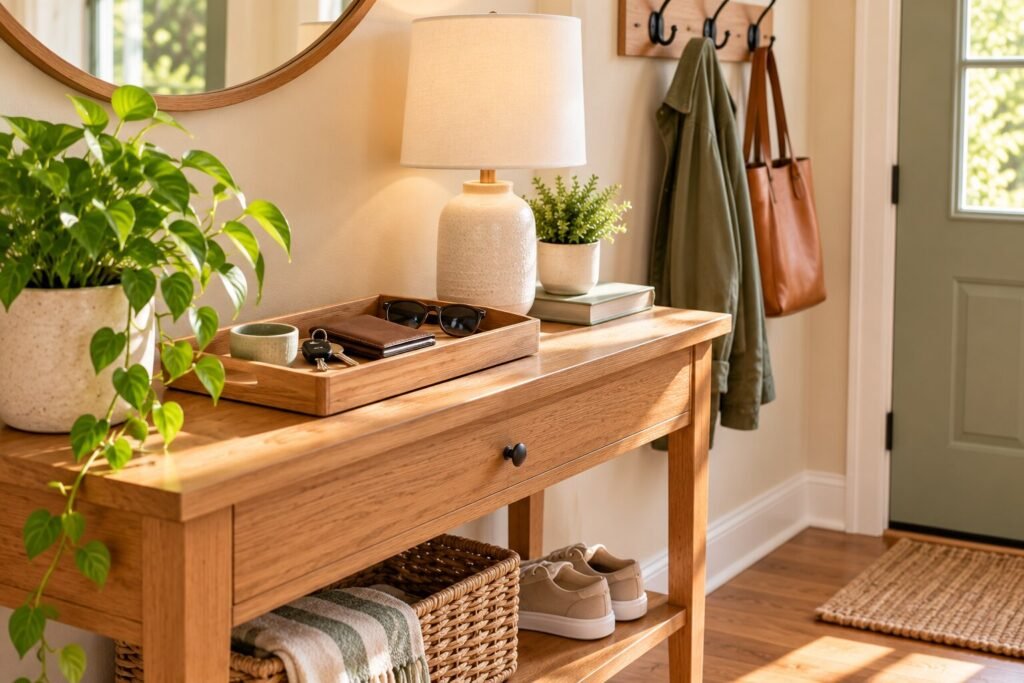
The fix: Give frequently used items a specific, consistent place to live.
Think about the things that tend to wander around your house: keys, wallets, sunglasses, scissors, tape, and charging cables.
A small tray near the door can hold everyday essentials. A designated drawer can keep household tools together. A basket beside the sofa can give remote controls a place to land.
The important part isn’t what you use for storage. It’s choosing a location that makes sense.
Let Your Habits Choose the Spot
If your keys always end up on the kitchen counter, a small tray there might work better than a hook in the hallway.
And if you always charge your phone beside the bed, storing the charger in another room probably isn’t going to become a lasting habit.
Pay attention to where you naturally reach for things, then build your storage around those patterns.
Nook & Noted Tip: If something keeps ending up in the same inconvenient spot, that’s a clue. Try creating its permanent home nearby instead of constantly moving it somewhere else.
2. Use a Flexible One-In, One-Out Rule
The problem: New things keep coming into your home, but the amount of storage space stays exactly the same.
The fix: For categories that tend to multiply, try a simple one-in, one-out approach.
When you buy a new sweater, consider donating one you no longer wear. If you bring home another coffee mug, take a look at whether there’s an older one you rarely use.
The idea is to keep certain categories from slowly expanding beyond the space available.
Think of It as a Guideline, Not a Rulebook
You don’t need to get rid of something every time you bring home a purchase.
Sometimes you’re replacing something worn out. Other times you’re buying something you genuinely need.
This approach works especially well for categories that tend to accumulate without much thought, such as clothing, mugs, reusable water bottles, and decorative accessories.
Keep Donations Easy
Designate a small bag or box for things you’re ready to donate.
When you come across something you no longer use, you can add it right away instead of setting it aside and forgetting about it.
Once the bag is full, make a plan to drop it off.
Nook & Noted Tip: Keep a small donation bag somewhere convenient. Decluttering is much easier when you can let go of things as you notice them instead of waiting for a major cleanout.
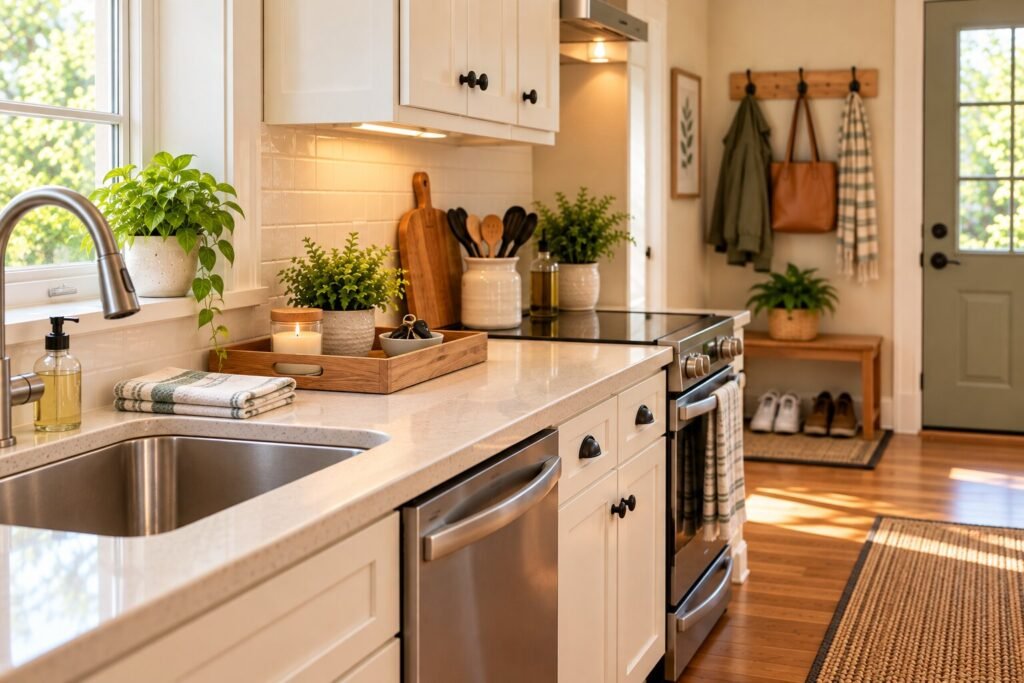
3. Create a Landing Zone Near the Door
The problem: Shoes, jackets, backpacks, mail, and shopping bags seem to pile up the moment someone walks through the door.
The fix: Create a small, designated landing zone near the entrance your household uses most.
This doesn’t have to be a fancy mudroom or a built-in entryway system.
A few hooks for jackets and bags, a shoe mat, and a small basket for incoming items may be all you need.
The goal is to give things an obvious place to go before they spread throughout the house.
No Entryway? No Problem.
If your front door opens directly into the living room, you can still create a landing zone.
Use a narrow section of wall, a small spot inside a nearby closet, or the side of an existing cabinet.
Keep the setup proportional to the space, and make sure it doesn’t block the doorway or walking path.
Keep It Focused on Everyday Items
Your landing zone should hold the things you actually use when coming and going.
If it becomes a storage spot for every jacket, pair of shoes, and bag your family owns, it’ll quickly turn into another cluttered area.
Nook & Noted Tip: Start small. A few hooks and one basket that everyone actually uses are more helpful than an elaborate setup that becomes another place to pile things.

4. Use a Daily Ten-Minute Reset
The problem: Small messes build up throughout the day until keeping the house tidy feels like another big project.
The fix: Set aside ten minutes to return everyday items to their designated spots.
This isn’t about deep cleaning or making every room look perfect. It’s simply a quick reset to keep little messes from becoming bigger ones.
Keep the Routine Simple
During your ten-minute reset, focus on a few things:
- Return stray items to their usual homes.
- Clear the kitchen counter or another frequently used surface.
- Put away shoes, bags, and jackets.
- Straighten up the living room.
- Set out anything you’ll need for the next morning.
You don’t have to finish everything. Just tackle what you can in the time available.
Make It a Routine You Enjoy
Try putting on a favorite playlist or podcast while you tidy.
You can also get other household members involved, with everyone taking responsibility for a small area.
And if evenings are already hectic, there’s no rule saying your reset has to happen before bed. Choose a time that works for your household.
Nook & Noted Tip: Set a timer and stop when it goes off. The goal is a small daily reset, not an unexpected deep-cleaning session.
5. Schedule a Simple Weekly Home Check-In
The problem: Paperwork, groceries, laundry, and household tasks seem to pile up until everything needs attention at once.
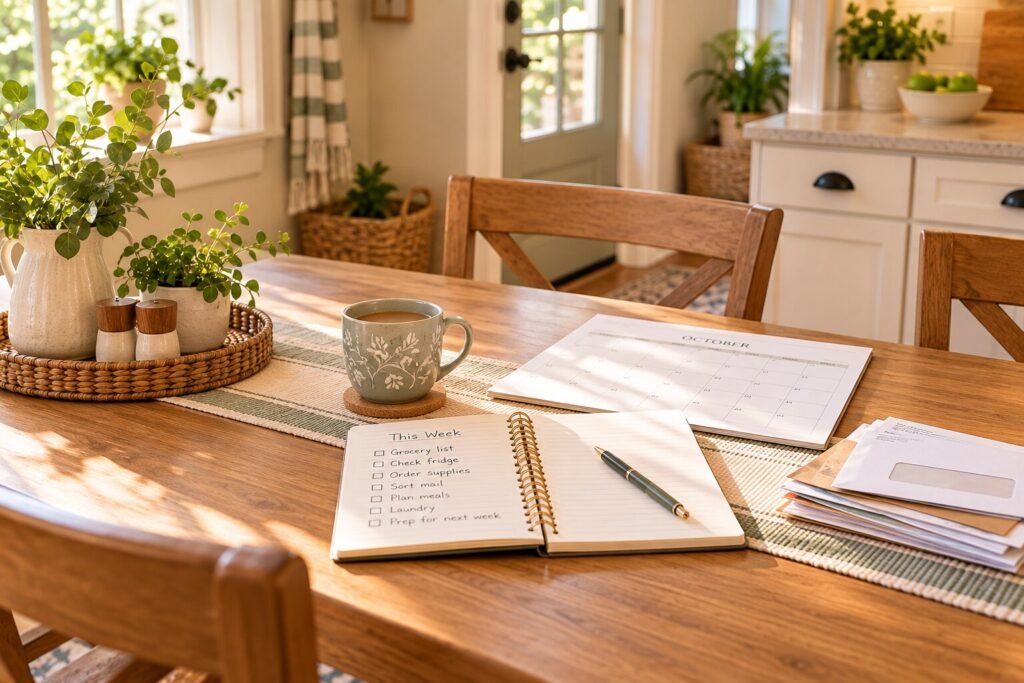
The fix: Choose a regular time each week to check in on the little things that don’t necessarily need attention every day.
Unlike your daily reset, which focuses on visible clutter, a weekly check-in helps you stay ahead of household tasks.
Spend about 15 to 20 minutes reviewing what needs attention and planning for the days ahead.
What to Include in Your Weekly Check-In
Depending on your household, you might:
- Sort mail and review paperwork that needs action.
- Check the refrigerator for leftovers and food that needs to be used.
- Make a grocery list and check which household supplies are running low.
- Look ahead at appointments and upcoming activities.
- Catch up on small organizing tasks you’ve been putting off.
You don’t need to complete every household chore during this time. The idea is to notice what needs attention before it becomes urgent.
Connect It to Something You Already Do
If you usually plan meals on Sunday, add your home check-in to that routine.
If you make a grocery list on Friday, use that time to review supplies and paperwork too.
The easier it fits into your existing schedule, the more likely you’ll keep doing it.
Nook & Noted Tip: Attach your weekly check-in to something you already do, like meal planning or making a grocery list. Building on an existing routine is often easier than creating a completely new one.
6. Organize Around Your Daily Routines
The problem: Things technically have a storage spot, but it’s not where you actually need them.
The fix: Instead of organizing everything strictly by category, try grouping items based on how you use them.
Think about the activities that happen regularly in your home and keep the supplies for each one together.
For example:
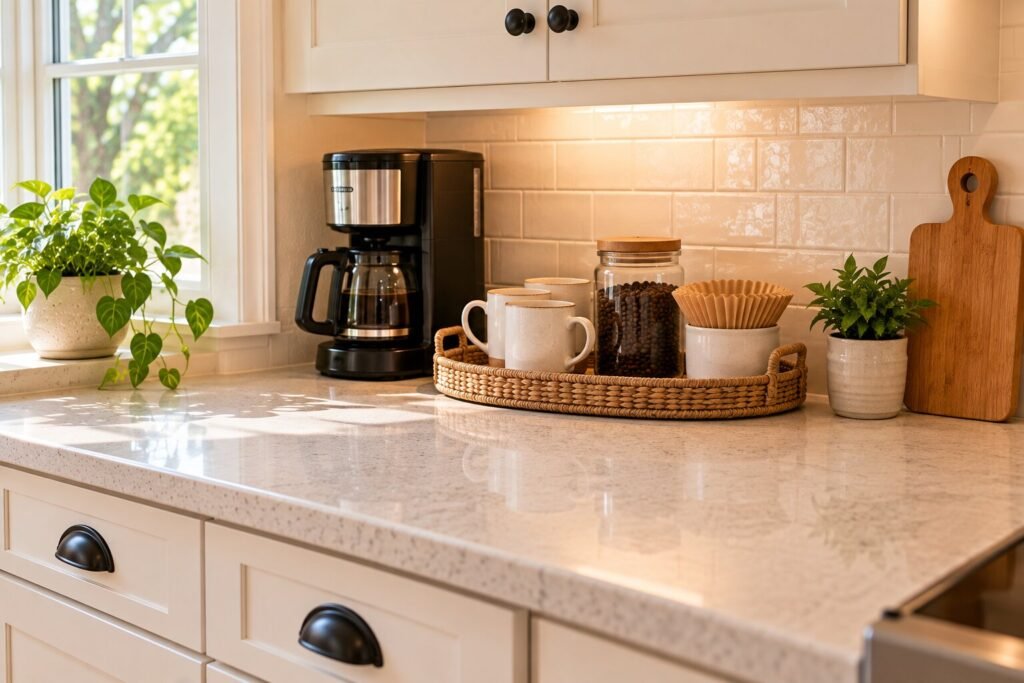
- Coffee station: Keep mugs, filters, and coffee supplies near the coffee maker.
- Lunch-packing area: Store lunch containers and reusable bags near the counter where lunches are prepared.
- Homework spot: Keep pencils, paper, and frequently used school supplies together.
- Cleaning supplies: Store appropriate supplies safely near where they’re used, following product storage directions and keeping hazardous products away from children and pets.
This makes everyday tasks easier because you’re not constantly gathering supplies from different parts of the house.
Make Putting Things Away Just as Easy
A system only works if it’s convenient to maintain.
If you have to walk across the house to return something to its designated spot, there’s a good chance it’ll get left out instead.
Look for ways to shorten the distance between where an item is used and where it’s stored.
Nook & Noted Tip: If you have to walk across the house to put something away, there’s a good chance it won’t happen consistently. Make the easiest choice the organized choice.
7. Label the Storage That Causes Confusion
The problem: Everyone in the house puts things back in different places, or nobody remembers what’s inside a particular basket or bin.
The fix: Add simple labels to the storage areas that regularly cause confusion.
You don’t need to label every drawer, cabinet, or shelf in the house.
Focus on shared spaces where clear labels would actually make everyday organization easier.
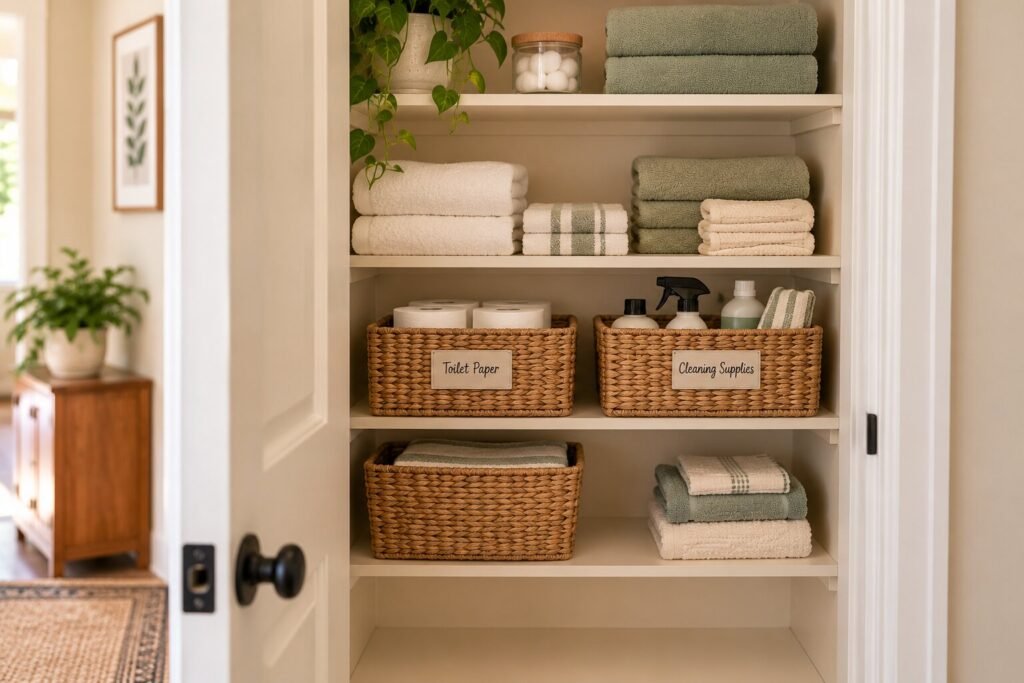
Pantry bins, toy baskets, linen closets, and household-supply containers are all good places to start.
Keep Labels Simple
Use everyday words that make sense to everyone in the household.
For example, labels like “Batteries,” “Snacks,” or “Extra Towels” are much more helpful than vague categories like “Miscellaneous.”
You don’t need a label maker, either. Masking tape and a marker can work perfectly well.
For younger children who aren’t reading yet, simple picture labels can make it easier to put toys and supplies away independently.
Don’t Overdo It
Labels are meant to make things easier, not create another organizing project.
If everyone already knows where the drinking glasses belong, you probably don’t need a label on that cabinet.
Save them for the spots where they genuinely help.
Nook & Noted Tip: Use simple, everyday words on labels. “Batteries” is more helpful than “Miscellaneous Household Essentials.”
8. Leave a Little Breathing Room
The problem: Every shelf, drawer, and cabinet is packed so tightly that putting something away requires rearranging everything else first.
The fix: Try not to fill every storage space to its absolute limit.
Leaving a little open room makes items easier to see, reach, and put back where they belong.
A shelf with some extra space is easier to maintain than one where everything has to be stacked or squeezed into place.
Think About How the Space Functions
In a linen closet, leaving a little room between stacks of towels makes it easier to pull one out without disturbing everything else.
In a kitchen drawer, having space around utensils helps prevent things from getting tangled or jammed.
And in a bedroom closet, a little breathing room between hanging clothes makes it easier to see what you own.
You don’t need a specific percentage of empty space. Just enough that the storage area works comfortably.
Don’t Turn Empty Space Into a Catch-All
Leaving room doesn’t mean creating a permanent spot for random things that don’t belong anywhere else.
The goal is to make your existing storage easier to use, not give clutter somewhere new to collect.
If a drawer or shelf is consistently overflowing, take a few minutes to edit what’s inside before adding more.
Nook & Noted Tip: If you have to push, squeeze, or rearrange everything just to put one item away, that storage area is probably too full.
Simple Systems Make an Organized Home Easier to Maintain
Getting organized is one thing. Keeping your home organized when life gets busy is another.
The good news is that you don’t need a complicated plan or a perfectly tidy house to make it work.
Start with one spot that constantly gets messy. Give everyday items a logical home, build a simple routine around how you already use the space, and see what changes over the next couple of weeks.
Once that system feels natural, move on to another area.
Little by little, those small changes can make your home easier to manage without requiring constant decluttering sessions or an entire Saturday devoted to cleaning.
And that’s really the goal—not a home that looks perfect all the time, but one that’s easier to put back together when real life happens.
Looking for More Home Organization Inspiration?
Looking for more ways to make your home feel organized and functional? Explore practical organization ideas, small-space solutions, and clever home finds from Nook & Noted.