Small kitchens can get cluttered fast. One grocery run, a few appliances on the counter, and suddenly it feels like there’s nowhere left to put anything.
But you don’t need a bigger kitchen—or an expensive renovation—to create more usable space.
The trick is making better use of the storage you already have: cabinet doors, walls, deep shelves, awkward corners, and even those few inches beside the refrigerator. A handful of simple organizers can make a surprisingly big difference, too.
Here are 15 small kitchen organization ideas to help you maximize storage, clear your counters, and make your kitchen easier to use every day.
Short on Time? Start With These 5 Easy Upgrades
If you don’t want to reorganize your entire kitchen this weekend, start small. These five upgrades can make an immediate difference:
- Clear pantry bins to group similar foods together.
- Lazy Susans for deep cabinets, corners, and condiments.
- Drawer dividers to control clutter.
- Cabinet-door organizers to use overlooked space.
- Removable adhesive hooks for lightweight kitchen essentials.
You can always tackle the bigger projects later. Sometimes fixing one frustrating cabinet or drawer is enough to make the whole kitchen feel more manageable.
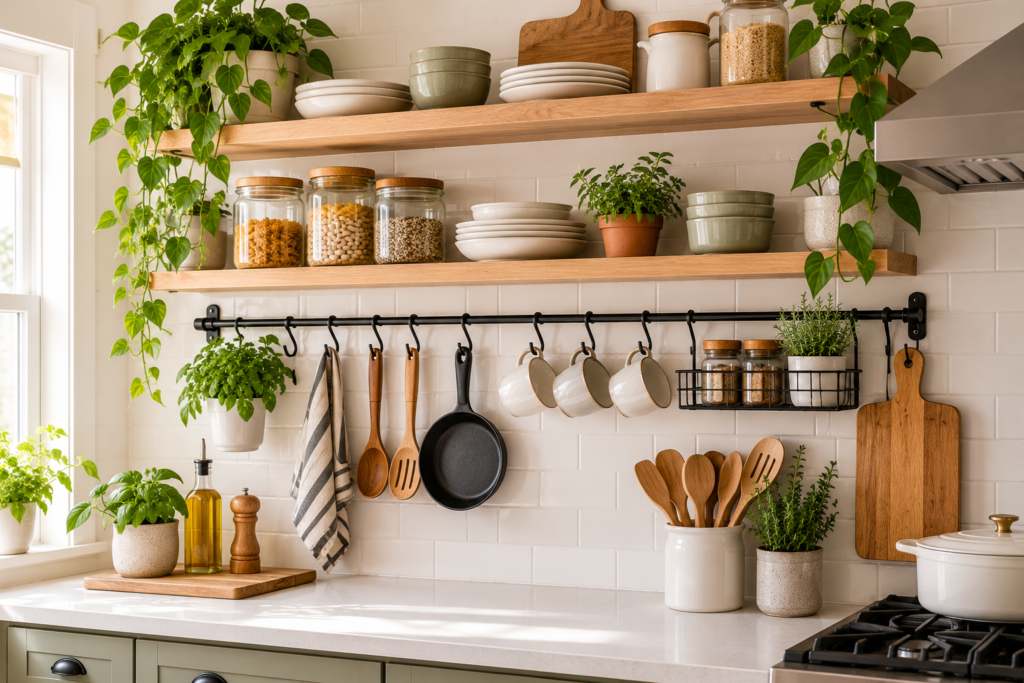
1. Go Vertical With Wall-Mounted Storage
When you can’t expand outward, try upward.
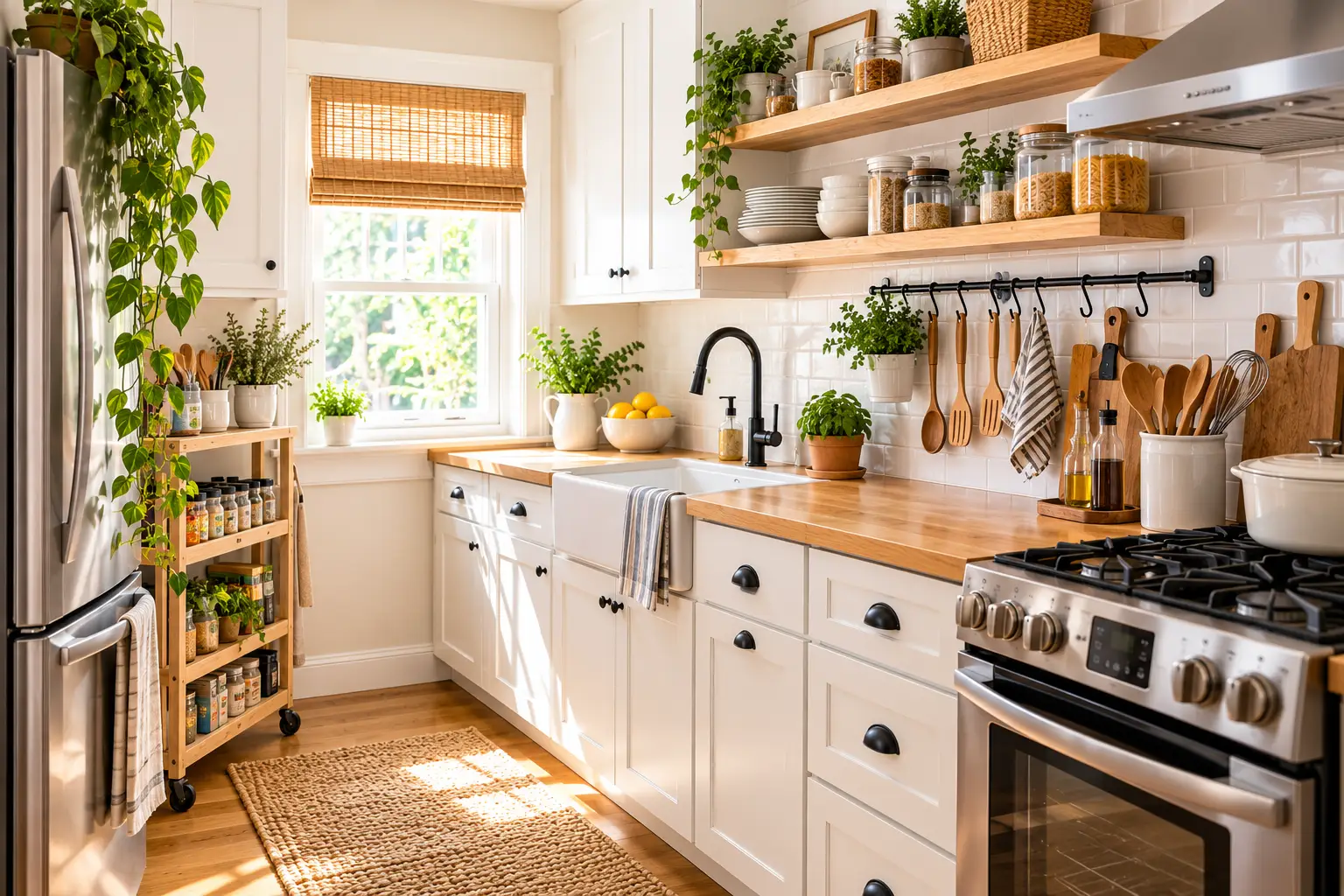
Empty wall space can become valuable kitchen storage with floating shelves, pegboards, hooks, or wall-mounted rail systems. They’re especially useful for items you reach for frequently, such as cooking utensils, mugs, small pans, or measuring cups.
A pegboard or rail system near your prep area, for example, can turn an unused wall into flexible storage without taking up a single inch of counter space.
Nook & Noted Tip: Don’t fill every inch of wall space. Leaving a little breathing room keeps a small kitchen from feeling visually cluttered.
Before installing: Make sure shelves, rails, and racks are properly anchored and rated for whatever you plan to store on them.
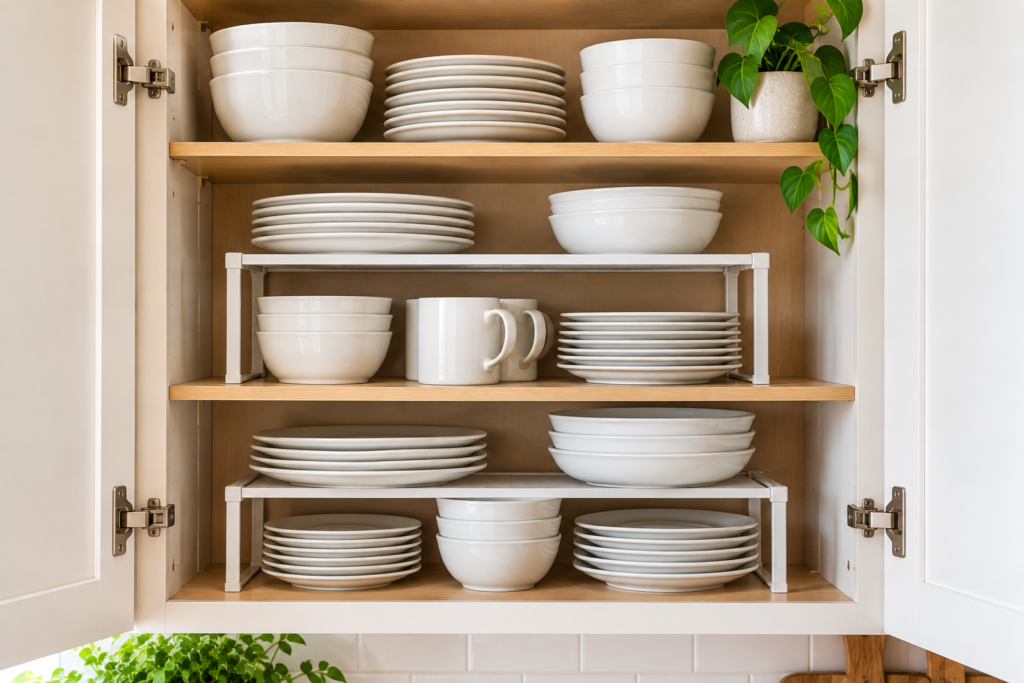
2. Double Cabinet Space With Shelf Risers
Sometimes the problem isn’t that a cabinet is too small. It’s that half of its vertical space isn’t being used.
Shelf risers create a second level inside a cabinet so you can store plates, bowls, mugs, pantry items, or baking supplies without stacking everything into one tall pile.
They work especially well in upper cabinets where there’s a large gap between shorter dishes and the shelf above.
What to look for: Choose a riser that fits your cabinet height and is sturdy enough for everyday use. Measure the tallest items you plan to store underneath before choosing the riser height.
Nook & Noted Tip: Before buying anything, experiment with the arrangement of your dishes. You may discover that simply grouping similar-sized items together already creates more usable space.
3. Use a Tension Rod Under the Sink
The cabinet beneath the kitchen sink often has a nasty habit of becoming a jumble of spray bottles, sponges, trash bags, and cleaning supplies.
One inexpensive solution is a tension rod. Position a sturdy rod across the cabinet and hang compatible spray bottles from their trigger handles. This can free up space on the bottom of the cabinet for baskets, bins, or other supplies.
Best for: Renters and anyone looking for an inexpensive storage upgrade that doesn’t require drilling.
Before you buy: Measure around your plumbing first. Pipes, garbage disposals, water filters, and other fixtures can dramatically reduce the usable space beneath a sink.
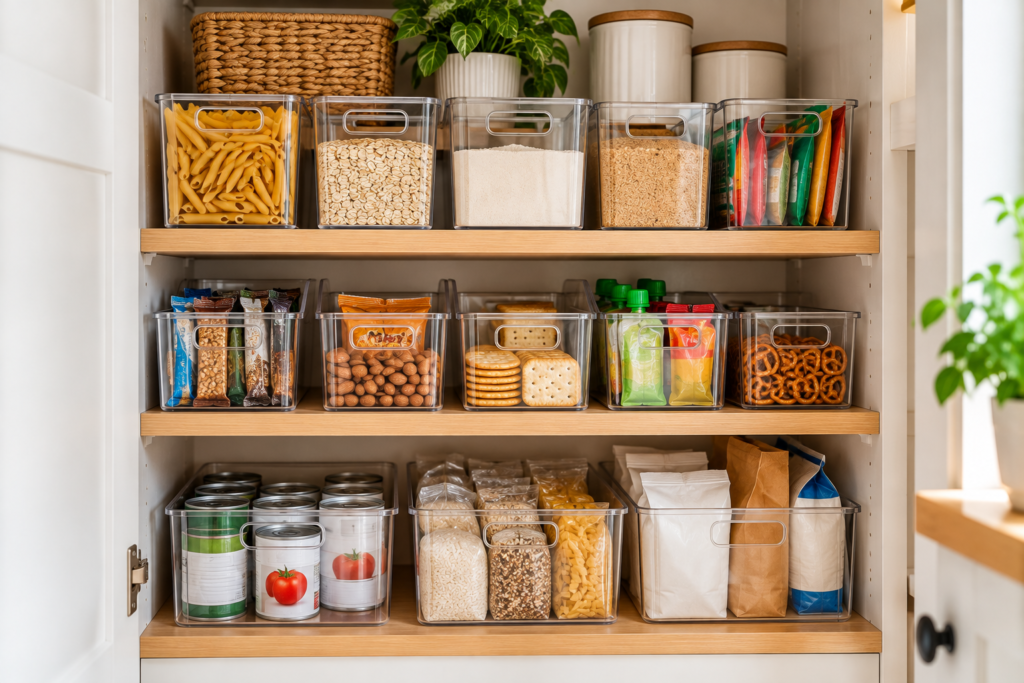
4. Organize Pantry Items With Clear Bins
Clear storage bins are one of the easiest ways to bring order to crowded pantry shelves and kitchen cabinets.
Instead of having snacks, packets, baking supplies, and canned goods scattered across a shelf, group similar items together. You might create separate bins for snacks, breakfast foods, baking supplies, pasta, or lunch-packing essentials.
Clear containers make it easy to see what you already have, too—which can help prevent discovering three unopened bags of the same thing hiding in the back of the cabinet.
What to look for: Rectangular bins with relatively straight sides generally make better use of shelf space than heavily tapered containers. Handles can also be helpful on higher shelves.
And don’t automatically assume everything needs a lid. Open-top bins can be more convenient for foods your family reaches for every day.
Before you buy: Measure the width, depth, and height of your shelves. Make sure there’s enough clearance for both the bin and anything stored inside it.
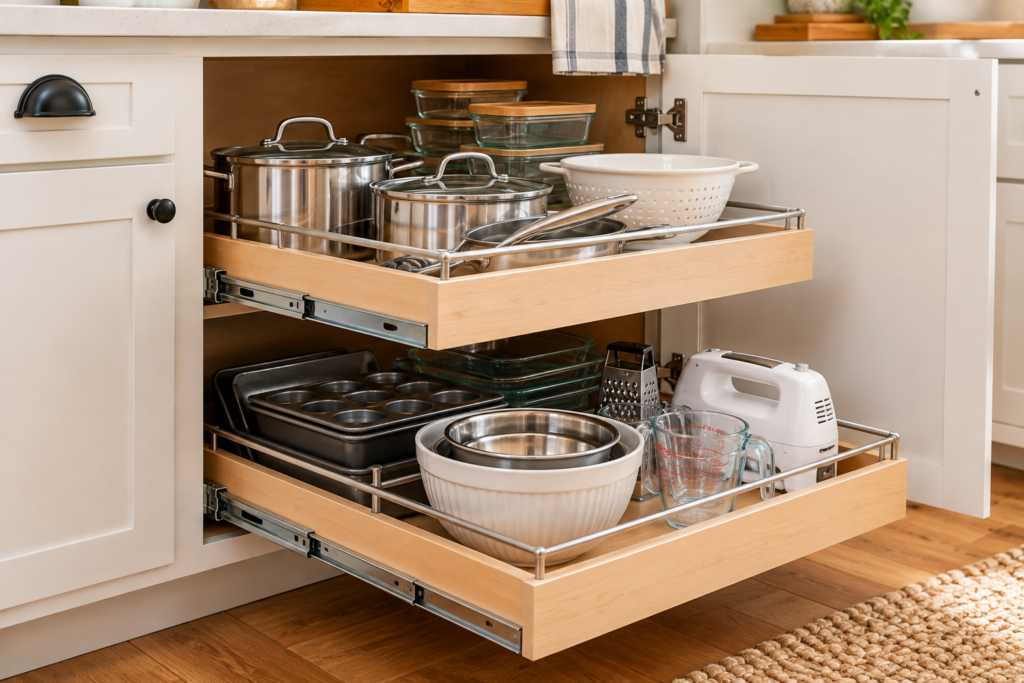
5. Add Pull-Out Storage to Deep Cabinets
Deep lower cabinets can provide plenty of storage, but sometimes half of it becomes almost inaccessible.
Instead of kneeling down and pulling everything out to find the mixing bowl hiding in the back, pull-out shelves or sliding organizers allow you to bring the contents of the cabinet toward you.
They can be especially useful for pots, pans, mixing bowls, small appliances, and pantry items.
Before you buy: Measure the cabinet’s interior width, depth, height, and actual door opening. Don’t assume the outside dimensions of the cabinet tell you how much usable space is inside.
Also check for hinges, pipes, shelves, or other obstructions that could prevent a sliding organizer from extending properly.
Worth considering: If you use the cabinet several times a day, smooth movement and sturdy construction may matter more than squeezing in the maximum amount of storage.
6. Hang Pots and Pans Instead of Stacking Them
Pots and pans can consume an enormous amount of cabinet space.
If your kitchen layout allows it, moving some cookware to a wall-mounted rail or pot rack can free up an entire cabinet while keeping frequently used pieces within easy reach.
Wall-mounted rails tend to have a smaller visual footprint than large ceiling-mounted racks, which can be helpful in compact kitchens.
You don’t need to display every pan you own, either. Hanging two or three pieces you use constantly may be enough to make a difference.
Safety first: Heavy cookware needs a properly secured mounting system. Always pay attention to installation requirements and weight limits.
7. Use Drawer Dividers for More Than Silverware
Drawer dividers aren’t just for forks and spoons.
They can organize measuring tools, bag clips, reusable straws, small kitchen gadgets, dish towels, spice packets, and all the miscellaneous items that tend to migrate around a drawer.
Adjustable dividers are particularly useful because you can create sections that fit what you actually own rather than forcing everything into a predetermined tray.
Before you buy: Measure the length, width, and especially the height of the drawer. A divider that’s slightly too tall can keep the drawer from closing.
Nook & Noted Tip: Don’t create more compartments than you need. A few clearly defined sections are usually easier to maintain than a drawer divided into dozens of tiny spaces.
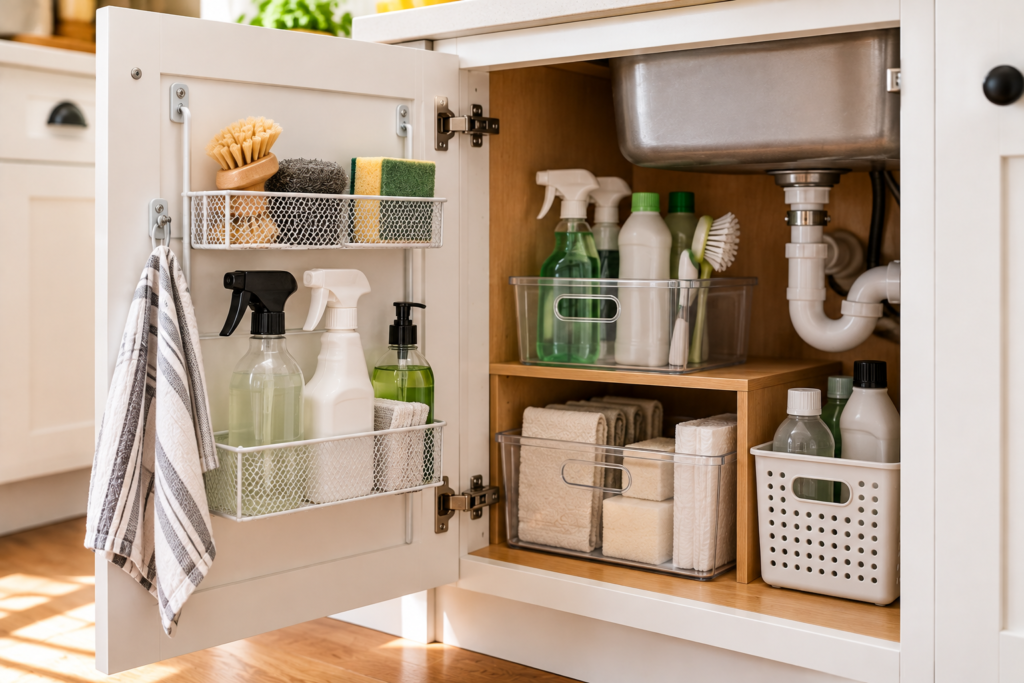
8. Put the Inside of Cabinet Doors to Work
Cabinet doors are some of the most overlooked storage spaces in a kitchen.
Depending on the cabinet, you may be able to add a slim rack, adhesive organizer, hooks, or a holder for items such as cutting boards and pot lids.
Under the sink, cabinet-door storage can also work well for sponges, brushes, dishwasher supplies, or other lightweight cleaning essentials.
Before installing anything: Check where the shelves sit inside the cabinet. Close the door slowly with the organizer temporarily positioned in place to make sure it and its contents won’t collide with a shelf.
This simple check can save you from installing an organizer that prevents the cabinet from closing.
9. Add a Slim Rolling Kitchen Cart
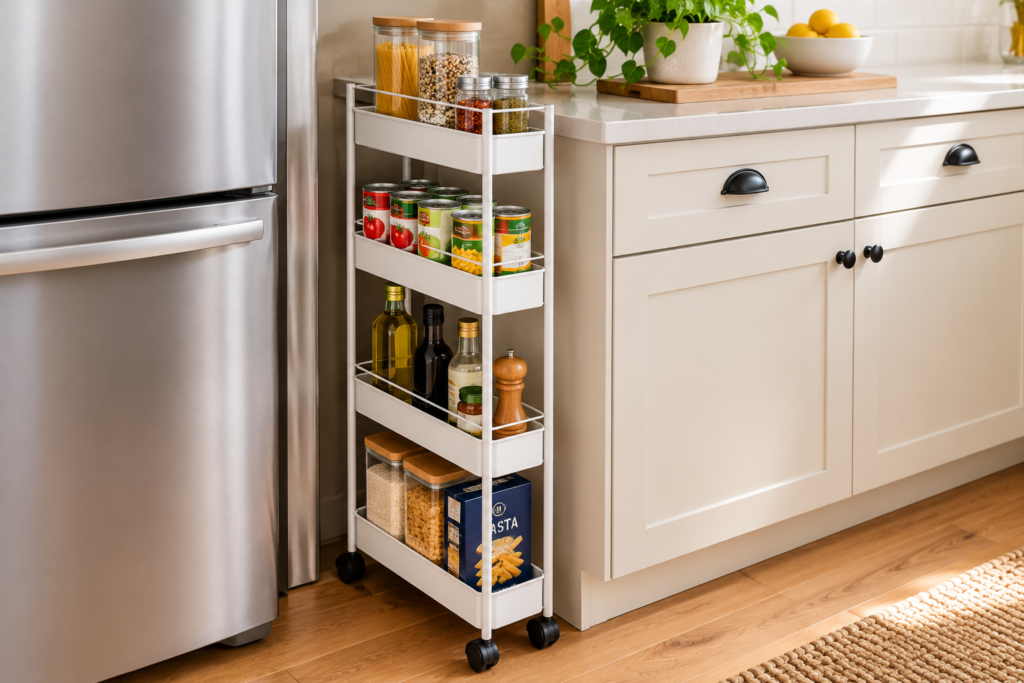
Have a narrow gap beside the refrigerator or at the end of a cabinet run? It might be more useful than you think.
A slim rolling cart can turn an awkward strip of floor space into storage for canned goods, bottled drinks, baking supplies, snacks, or other kitchen essentials.
A somewhat larger cart can also provide movable storage or additional prep space if your kitchen is short on countertops.
Before you buy: Measure the gap at several points. Walls, baseboards, floors, and cabinets aren’t always perfectly straight, and you’ll want enough clearance for the cart to move easily.
Also consider what will be stored on the cart. A very narrow cart filled with heavy bottles may be less stable than one holding lightweight pantry items.
10. Use Lazy Susans in Deep Cabinets and the Refrigerator
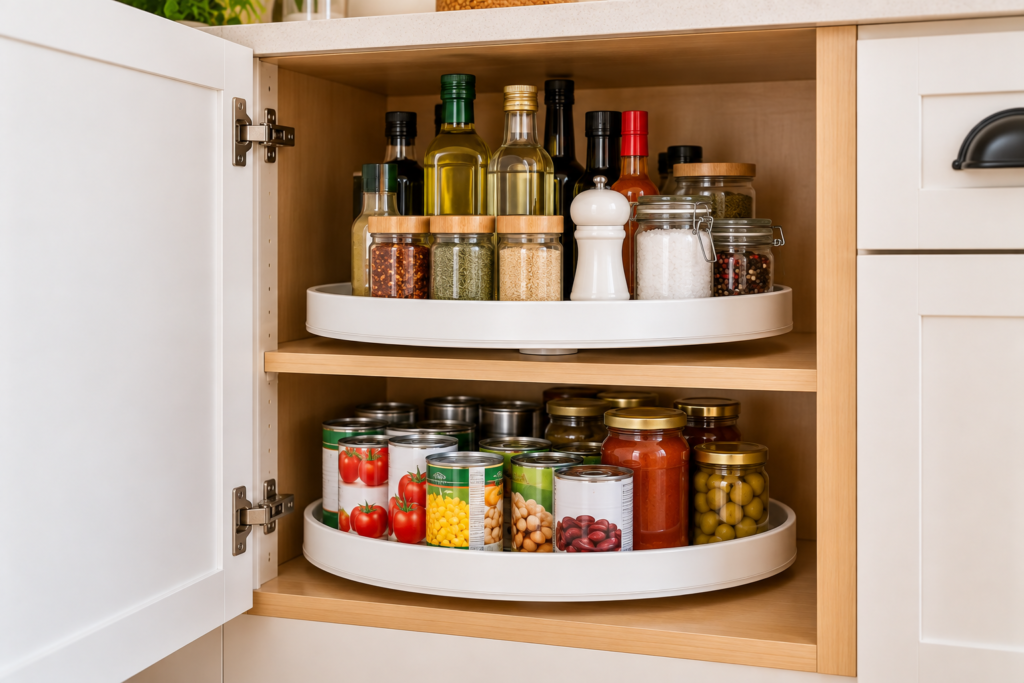
Deep shelves and corner cabinets are notorious for hiding things.
A rotating organizer—often called a Lazy Susan—lets you bring items from the back of the shelf to the front with a quick spin.
They’re particularly handy for oils, vinegar, sauces, condiments, spices, jars, and smaller pantry items. They can work surprisingly well in the refrigerator, too.
One feature worth having: A raised outer edge can help keep bottles from tipping when the organizer rotates.
Before choosing one, measure the shelf carefully. Check the diameter as well as the height of the bottles you plan to store so they won’t hit the shelf above.
Nook & Noted Tip: Bigger isn’t always better. Choose a turntable that rotates freely without hitting the cabinet door, wall, or nearby items.
11. Create Extra Prep Space With a Fold-Down Shelf
Sometimes storage isn’t the biggest problem in a tiny kitchen. It’s having enough room to actually prepare food.
A wall-mounted fold-down shelf or table can provide an extra work surface when you need it and fold nearly flat when you’re finished.
Depending on the location and size, it might also work as a tiny breakfast table, laptop spot, or compact coffee station.
What to consider: Check the weight capacity, mounting requirements, and surface material. If you plan to use it for food preparation, choose something sturdy and easy to clean.
This solution isn’t ideal for every rental because secure wall mounting is typically required.
12. Use Removable Adhesive Hooks Strategically
Sometimes the simplest ideas make a surprising difference.
Removable adhesive hooks can create storage for lightweight items without permanently altering cabinets or walls.
Try them for oven mitts, aprons, measuring spoons, lightweight utensils, dish brushes, or other small essentials. The sides of cabinets and the inside of cabinet doors are especially useful locations.
Best for renters: Adhesive hooks can be a convenient option when drilling isn’t allowed.
Before installing: Follow the manufacturer’s instructions for surface preparation, weight limits, and removal. Steam, grease, humidity, and textured surfaces can all affect how well adhesive products hold.
Note – Resist the urge to put hooks everywhere. Use them where they solve a specific storage problem rather than simply creating more visual clutter.
13. Store Pot Lids and Baking Sheets Vertically
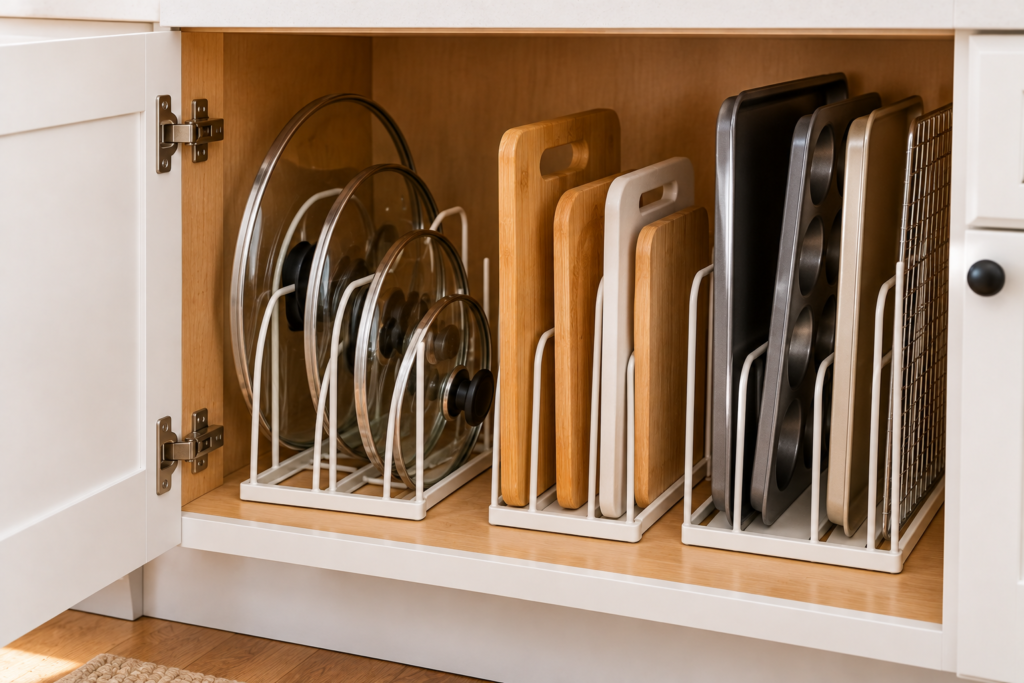
Opening a cabinet and having three pot lids slide toward you is a good sign that it’s time for a different system.
Instead of stacking lids horizontally, store them vertically.
A divided organizer can keep lids separated so you can grab the one you need without disturbing everything else. The same idea works beautifully for cutting boards, baking sheets, muffin pans, cooling racks, and serving trays.
What to look for: Pay attention to spacing. If you have lids with large handles, make sure there’s enough room between dividers.
Adjustable spacing can be especially useful if you’re organizing a combination of thin baking sheets and thicker cutting boards or pan lids.
14. Follow a Simple “One In, One Out” Rule
You can buy all the organizers in the world, but eventually a small kitchen will feel crowded again if more things keep coming in.
Try a simple habit: When a new kitchen item comes in, consider whether an older item can go.
Bought a new travel mug? Take a look at the eight already in the cabinet.
Upgraded your blender? Decide whether you genuinely need to keep the old one.
Added a new set of food-storage containers? This might be a good time to match up the old containers and lids and let go of the pieces you no longer use.
This doesn’t need to be a rigid rule. The goal is simply to pause before adding another item to a kitchen where every cabinet counts.
And unlike most organization solutions, this one costs nothing.
15. Label the Storage That Actually Needs It
Labels can make shared storage systems easier to maintain, but that doesn’t mean every jar, basket, cabinet, and drawer needs one.
Pantry bins labeled Snacks, Baking, Breakfast, or Pasta make it obvious where things belong—especially when several people use the same kitchen.
The key is moderation.
Too many labels can make a small space feel busier rather than calmer. Instead, label the containers and shelves where a little guidance will actually help your household maintain the system.
If everyone already knows where the coffee mugs belong, you probably don’t need a label telling them.
Before You Buy More Organizers, Do This!
It’s tempting to begin an organization project by ordering a collection of matching bins, baskets, and containers.
Start with a measuring tape instead.
Before buying anything:
- Empty the problem area.
- Remove anything you no longer use or need.
- Group similar items together.
- Measure the available space.
- Identify the actual storage problem.
- Then decide whether an organizer would solve it.
For cabinets and drawers, measure the width, depth, and height. For rolling carts, measure both the available floor space and the clearance needed to pull the cart out.
For door-mounted storage, check whether the organizer will clear the shelves when the door closes.
And before buying a large set of matching containers, try organizing one shelf first. You may discover you need fewer organizers—or a completely different type—than you originally expected.
A simple organizer that fits perfectly is far more useful than an elaborate storage system that almost fits.
Small Kitchen Organization FAQs
How do I organize a small kitchen with very little storage?
Start by decluttering before adding organizers. Then look for unused space rather than trying to fit more into already crowded cabinets. Empty walls, cabinet doors, vertical cabinet space, deep shelves, the area under the sink, and narrow gaps beside appliances can all provide additional storage opportunities.
Focus first on the area that causes the most frustration. Solving one overcrowded cabinet or cluttered countertop can make the entire kitchen easier to use.
How can I create more counter space in a small kitchen?
Move items you don’t use every day off the counter and give frequently used tools a dedicated home. Wall-mounted rails, shelves, cabinet-door storage, and hooks can move certain items off your work surface.
If space allows, a rolling cart or fold-down shelf can also provide temporary prep space when you need it.
What should I organize first in a small kitchen?
Start with the space that causes problems most often.
If you’re constantly moving appliances to prepare dinner, tackle the countertops. If food disappears in the back of your pantry, start there. If finding a pan requires removing six other pans first, reorganize that cabinet.
You don’t have to organize the entire kitchen at once. Fixing the most frustrating area first usually gives you the biggest immediate payoff.
What are some renter-friendly small kitchen organization ideas?
Tension rods, freestanding shelf risers, drawer dividers, clear storage bins, rolling carts, and certain removable adhesive hooks can add organization without major permanent changes.
Always check your lease before installing anything on walls or cabinets, and follow manufacturer instructions when using removable adhesive products.
The Bottom Line
A small kitchen doesn’t have to feel cramped or chaotic.
Often, the biggest improvements come from making better use of spaces that were already there: an empty wall, the back of a cabinet door, the vertical space between shelves, or that narrow gap beside the refrigerator.
You don’t need to tackle all 15 ideas at once, either.
Start with the spot that frustrates you most. Add a Lazy Susan to that impossible corner cabinet. Organize the snack shelf with a couple of bins. Get the pot lids standing upright instead of tumbling out of the cabinet.
Then live with the change for a while before moving on to the next problem area.
Small changes add up. And when the things you use have sensible places to live, even a tiny kitchen can feel calmer, more functional, and surprisingly spacious.