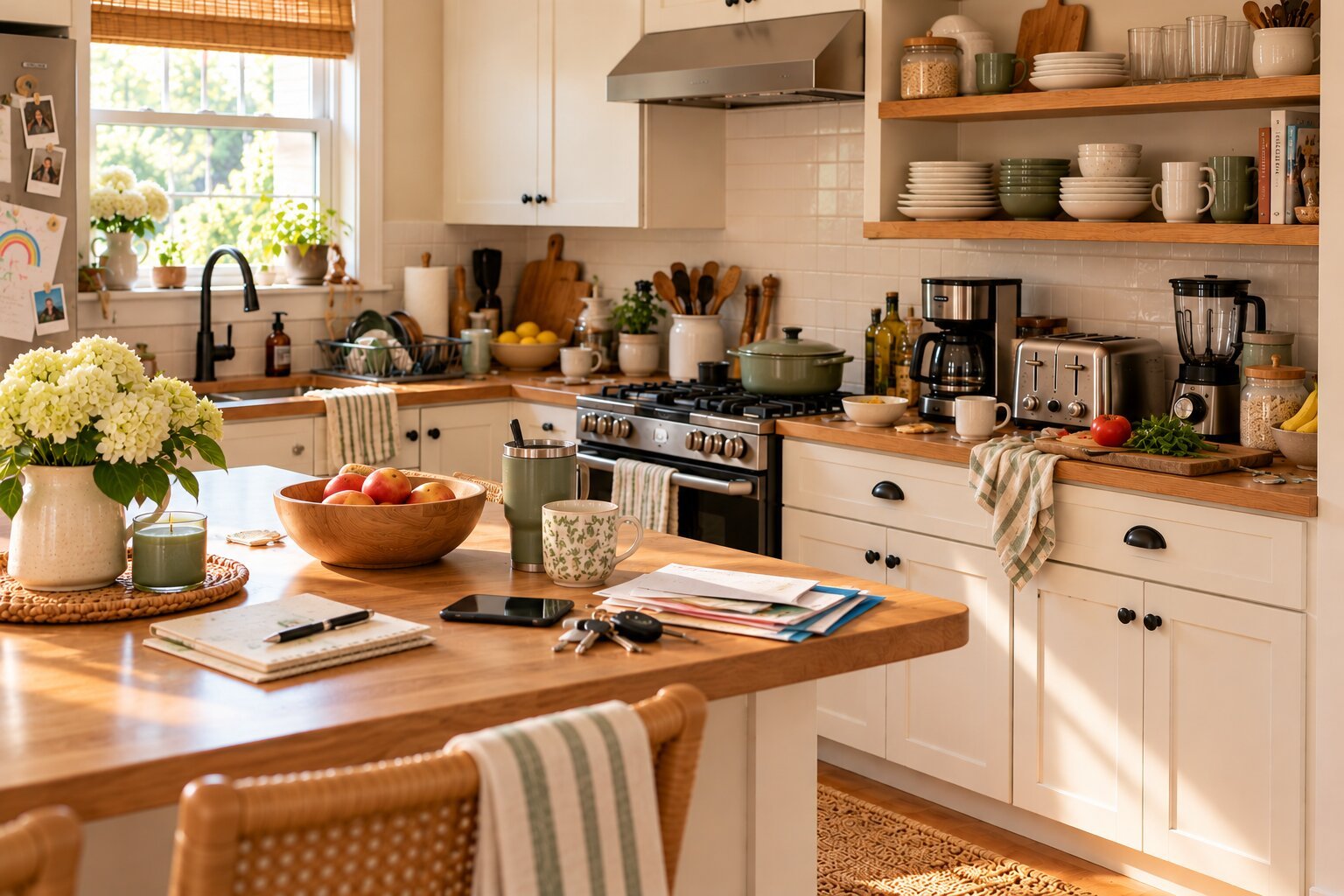
Some kitchens are cluttered because they’re small. Others feel cluttered because of a dozen little habits that quietly add up—one extra gadget here, one stack of mail there—until the counters are full and nobody remembers exactly how it happened.
The good news is that kitchen clutter isn’t always a space problem. Often, it’s a handful of specific, fixable habits, and once you spot them, the solutions can be surprisingly simple.
Here are ten common things that can make a kitchen feel more cluttered—and practical ways to fix them without reorganizing the entire room.
Before You Start Organizing, Figure Out What’s Actually Cluttering Things
It’s tempting to see a cluttered kitchen and immediately start shopping for bins and baskets.
But before you organize anything, figure out what’s actually causing the problem.
Is there simply too much stuff?
Do the things you own lack a designated home?
Or do they technically have a home, but it’s so inconvenient that nobody ever puts them there?
Those are three very different problems—and they need different solutions.
Take a slow walk through your kitchen and notice where your eye naturally snags.
Maybe it’s the crowded counter beside the refrigerator.
Maybe it’s the cabinet you have to rearrange every time you put away a clean mug.
Maybe it’s the pantry shelf where three half-used bags of the same ingredient are quietly living separate lives.
The problem usually isn’t the drawer you already keep tidy. It’s the spot you quietly avoid looking at.
Nook & Noted Tip: Clutter isn’t a character flaw. It’s usually just a system that hasn’t caught up with how you actually use the space.
1. The Counter That’s Become a Catch-All
Nearly every kitchen has one.
It’s the spot where mail, keys, school papers, receipts, sunglasses, and random things that need to go somewhere else get dropped.
One surface can quietly become the landing zone for the entire household.
The problem isn’t necessarily that people put things there. In many homes, having a landing spot near the door or kitchen is genuinely useful.
The problem starts when that landing spot has no boundaries—and no exit plan.
Give It a Boundary—and an Exit Plan
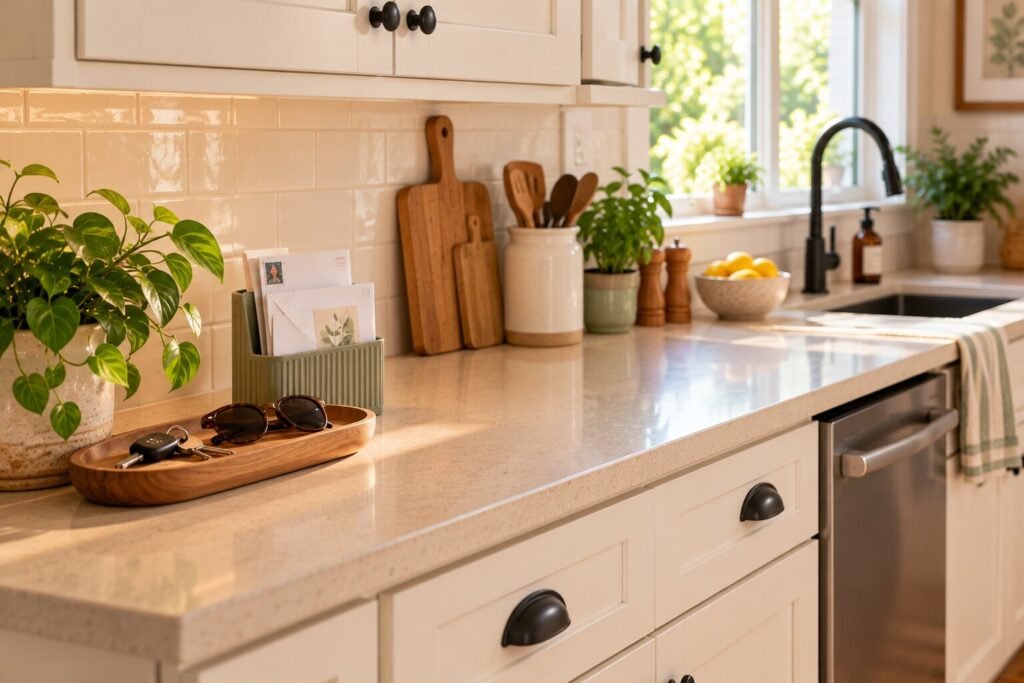
Instead of trying to eliminate the habit completely, create a small, defined landing zone.
A shallow tray might hold keys and sunglasses.
A small upright holder or basket can temporarily contain papers that need attention.
Then keep the rest of the counter clear for actual kitchen tasks.
The second part is just as important: regularly move things out.
Mail gets sorted.
School papers go where school papers belong.
Receipts get filed, recycled, or dealt with.
And the mystery screw that has been sitting there for three weeks finally gets a decision.
Nook & Noted Tip: A catch-all spot isn’t a failure—it’s realistic. Give it a boundary, then regularly move out the things that don’t belong there.
2. Appliances That Rarely Earn Their Counter Space
Small appliances can take over a kitchen surprisingly quickly.
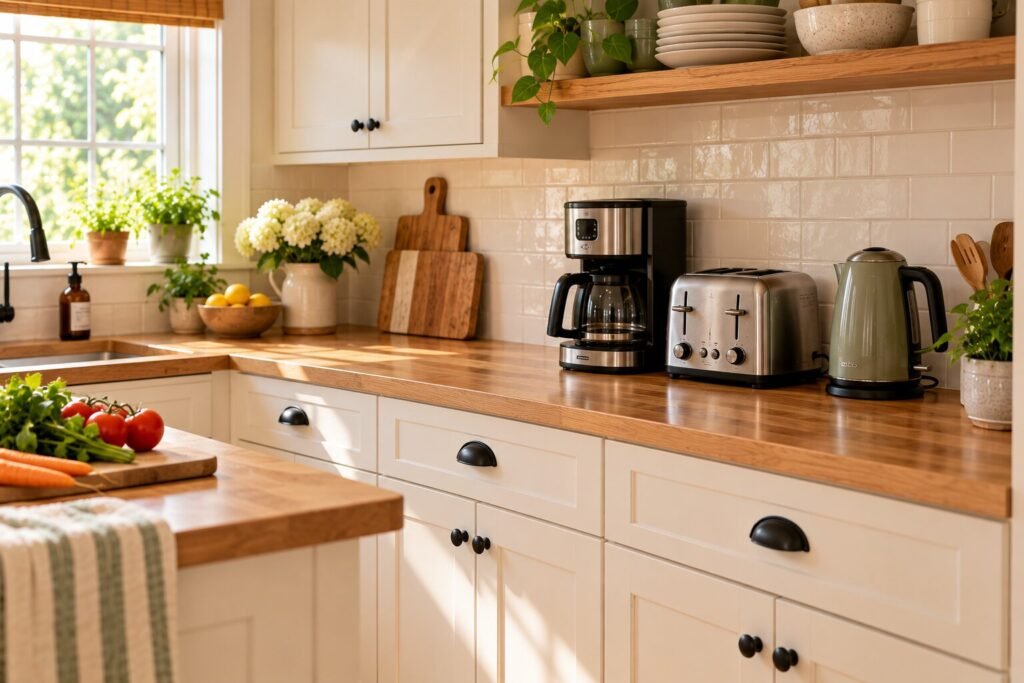
The coffee maker gets a permanent home.
Then the toaster.
Then the blender.
Then the air fryer.
And somewhere along the way, the waffle maker that comes out twice a year has also secured premium countertop real estate.
You don’t necessarily need to get rid of appliances you use occasionally and genuinely enjoy.
They just don’t all need to live within arm’s reach.
Match the Storage Spot to How Often You Use It
Think of appliance storage in three general categories:
Daily or weekly use: Keep these easy to reach.
Occasional use: Move these to a higher cabinet, deeper pantry shelf, or another accessible storage area.
Rarely used and no longer wanted: Consider whether they’re still worth storing at all.
The goal isn’t an empty counter. It’s enough open counter space to comfortably prepare food and use the kitchen.
Nook & Noted Tip: If you genuinely use an appliance only occasionally, it can still earn a place in your home—it just may not need prime kitchen real estate.
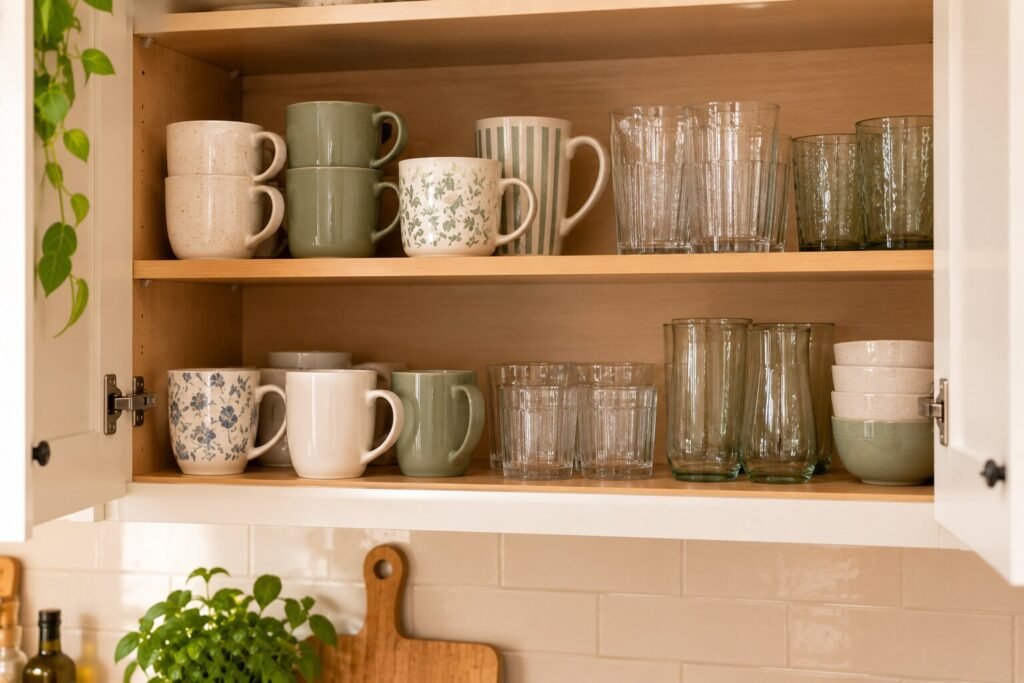
3. Too Many Mugs, Cups, and Glasses
Mug collections have a way of growing without anyone officially deciding to collect mugs.
There’s the favorite coffee mug.
The holiday mug.
The souvenir mug.
The gift mug.
The free mug from a conference three jobs ago.
Eventually, the cabinet is packed so tightly that putting away one clean cup requires a small game of kitchen Tetris.
Keep What Fits the Space Comfortably
Take everything out and look at the collection as a whole.
Separate it into a few categories:
- Everyday favorites
- Glasses and mugs you actually use for guests
- Sentimental pieces you genuinely want to keep
- Items nobody ever seems to choose
Then decide what deserves convenient cabinet space.
You don’t need an arbitrary number of mugs per person, and you don’t need a perfectly matching collection.
You simply need enough room for the things you use to be easy to take out—and easy to put back.
Nook & Noted Tip: If putting away one clean mug requires rearranging everything else in the cabinet, the collection probably needs an edit.
4. A Junk Drawer With No Structure
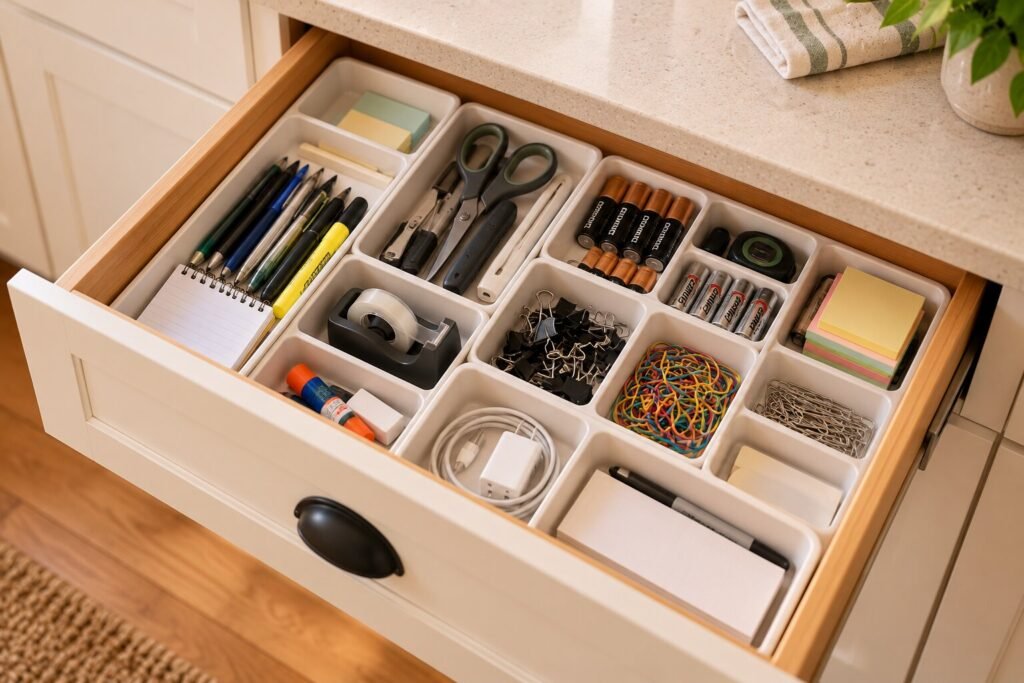
Nearly every kitchen is allowed one junk drawer.
It’s where pens, tape, batteries, scissors, rubber bands, clips, and that one tiny mystery part you’re afraid to throw away all end up living together.
The drawer itself isn’t necessarily the problem.
The problem is when everything inside it becomes one constantly shifting pile.
Edit First, Divide Second
Before buying drawer organizers, empty the whole thing.
Get rid of obvious trash and dead pens.
Move items that clearly belong somewhere else.
Group similar things together.
Then look at what’s left.
Simple modular trays or adjustable dividers can create sections for the categories you actually have rather than forcing your stuff into compartments that don’t make sense.
The goal isn’t to transform your junk drawer into a museum exhibit.
It’s simply to be able to find the scissors without excavating the entire drawer.
Nook & Noted Tip: Every kitchen is allowed one junk drawer. The goal isn’t zero chaos—it’s contained chaos.
5. A Food-Storage Container Collection That’s Taken Over
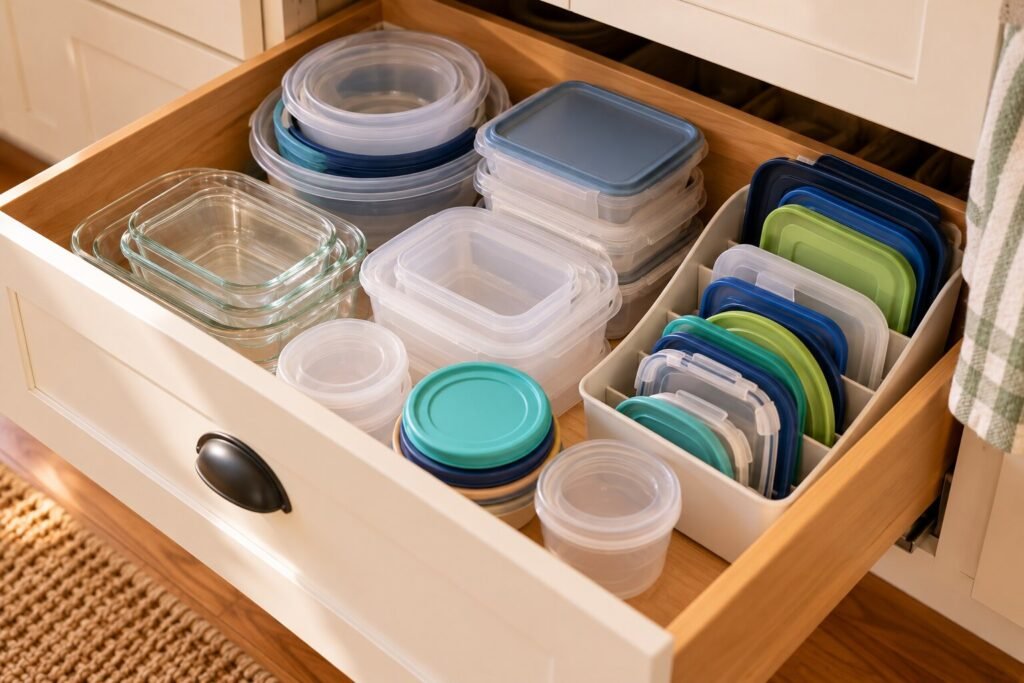
Lidless containers.
Containerless lids.
Stacks that collapse every time you reach for the one at the bottom.
Food-storage containers can become their own clutter problem surprisingly fast.
The solution doesn’t have to be throwing everything out and replacing it with one beautiful matching set.
Start with what you already have.
Match the Lids, Then Simplify the Collection
Pull everything out and match each container with its lid.
Set aside damaged pieces and identify containers or lids that no longer have a partner.
Then look at what remains.
Which sizes do you actually use?
Which containers nest together well?
Could the lids be stored vertically so they’re easier to see and grab?
You may find that simply removing unusable pieces and grouping compatible containers makes the whole collection significantly easier to manage.
Matching containers can be convenient, but they’re not required.
A practical collection that nests well and is easy to put away works just fine.
Nook & Noted Tip: If you have to dig through five lids to find the right one, your storage solution may have become its own clutter problem.
6. Gadgets That Don’t Earn Their Drawer Space
Kitchen gadgets are very good at making themselves sound essential.
There’s a specialized tool for slicing, peeling, cutting, coring, scooping, pressing, measuring, and performing tasks you didn’t know required their own piece of equipment.
But a single-purpose gadget isn’t automatically clutter.
If you use it regularly and it makes a kitchen task easier, it deserves its spot.
The problem is the collection of specialized tools you rarely—or never—reach for.
Judge Them by Usefulness, Not Novelty
Go through your gadget drawer and ask a simple question:
Do I actually use this?
If the answer is yes, keep it.
If the answer is “I forgot I owned that,” it may be worth reconsidering.
And if you own several tools that perform essentially the same task, decide which one you actually prefer.
You don’t need to eliminate every specialized kitchen tool.
You just want the space they occupy to reflect how useful they are to you.
Nook & Noted Tip: A gadget earns its space by being useful—not by being clever.
7. Open Shelving That’s Doing Too Much
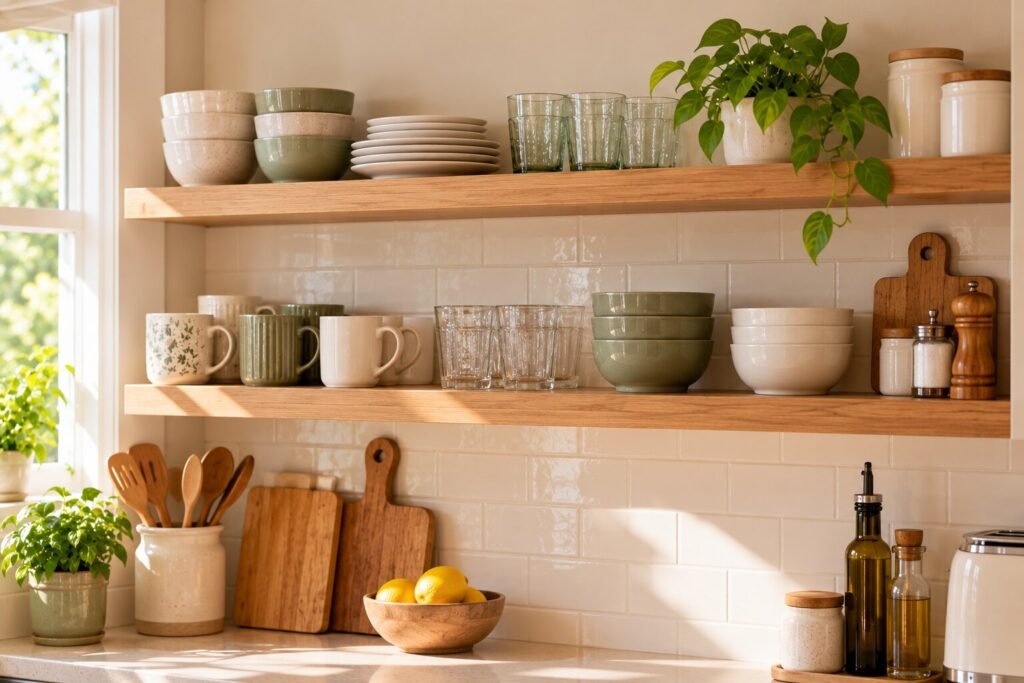
Open shelving can make a kitchen feel light and attractive.
It can also become visual clutter remarkably quickly.
The problem is that open shelves are both storage and display. Everything on them becomes part of what you see when you look around the room.
Twenty neatly organized objects can still look busy when they’re all visible at once.
Leave a Little Breathing Room
Use open shelving for things that make sense to keep visible and accessible.
That might include:
- Everyday dishes
- Drinking glasses
- A few frequently used serving pieces
- A small plant
- One or two decorative items you genuinely enjoy
Everything else doesn’t need to be on display.
Closed cabinets are useful precisely because they allow everyday necessities to disappear from view.
And don’t feel obligated to fill every available inch of a shelf.
Empty space is doing something too.
Nook & Noted Tip: Open shelving needs some breathing room to feel intentional. If every inch is occupied, remove a few things and see whether the whole kitchen immediately feels calmer.
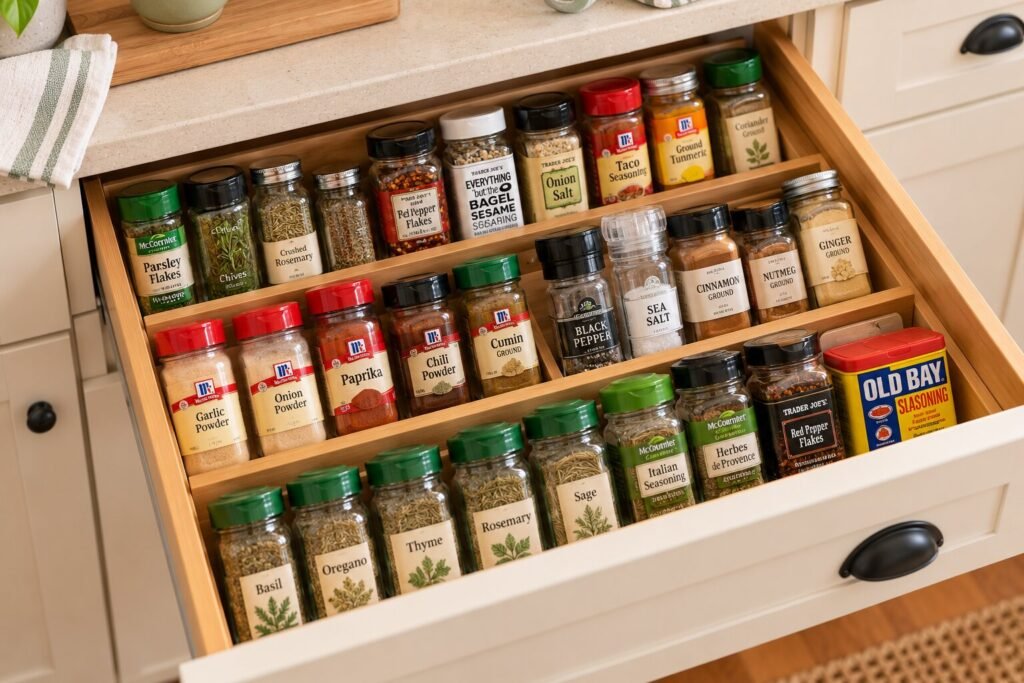
8. A Spice Collection You Can’t Actually See
Spices have a habit of multiplying.
Different brands come in different bottle sizes.
New jars get pushed in front of old jars.
You buy cumin because you can’t find the cumin you already have.
Eventually, finding one spice involves moving six others out of the way.
The answer doesn’t have to be transferring every spice you own into matching decorative jars.
Pretty? Sure.
Necessary? Not at all.
Make What You Own Easy to See
The best spice system is the one that lets you quickly see what you have.
Depending on your kitchen, that might mean:
- A shallow spice drawer
- A tiered shelf riser
- A small turntable
- Grouping spices by type
- Alphabetizing them
- Keeping your most frequently used spices easiest to reach
Use whichever system feels natural to you.
While you’re organizing, check jars that have been sitting around for a long time. If the aroma and flavor have noticeably faded, it may be time to replace them.
The goal isn’t matching containers.
It’s knowing what you own before you buy another one.
Nook & Noted Tip: A good spice system should help you find oregano—not require twenty identical jars and an afternoon with a label maker.
9. Too Much Stuff Living on the Refrigerator
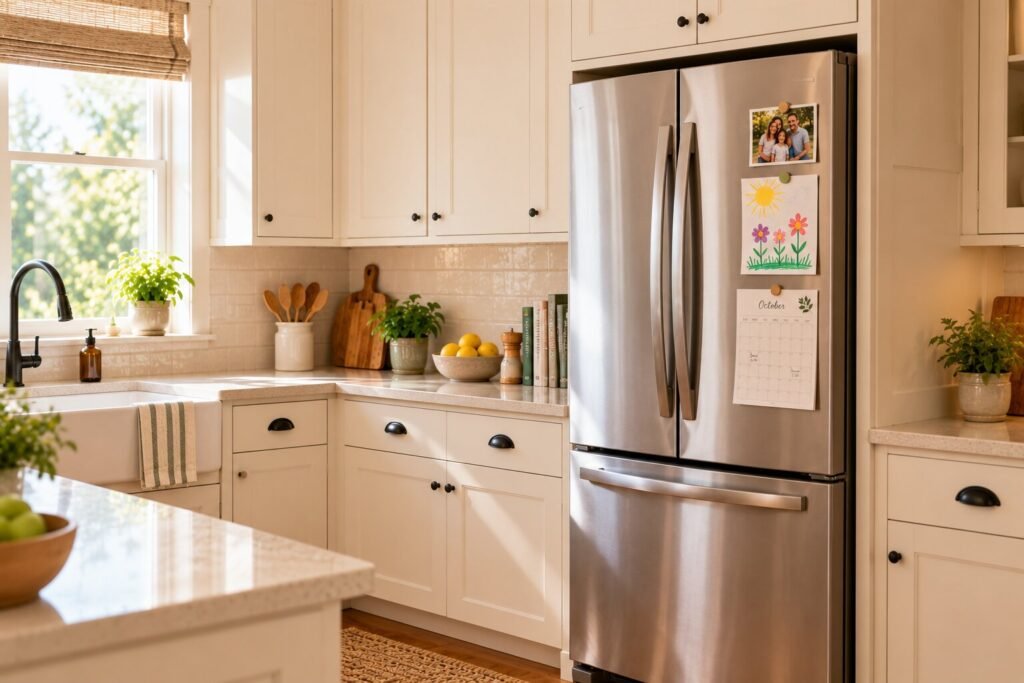
The refrigerator may be one of the largest visual surfaces in your kitchen.
Which also makes it very easy for it to become the household bulletin board.
Photos.
School artwork.
Invitations.
Coupons.
Appointment cards.
Calendars.
Takeout menus.
Magnets from vacations you barely remember.
None of those things are bad on their own. But when everything stays up indefinitely, the refrigerator can make the entire kitchen feel busier.
Create a Rotation
You don’t need to turn the refrigerator into a blank white box.
Keep the things you currently enjoy or need to see.
Maybe that’s one piece of children’s artwork, a favorite photo, and a current reminder.
Move important paperwork to wherever you actually deal with it.
Recycle outdated information.
And rotate sentimental things instead of trying to display everything at once.
You’ll still have personality—just with a little more breathing room.
Nook & Noted Tip: Your refrigerator can hold memories without holding every paper that’s entered the house since March.
10. Pantry Items You’ve Forgotten You Have
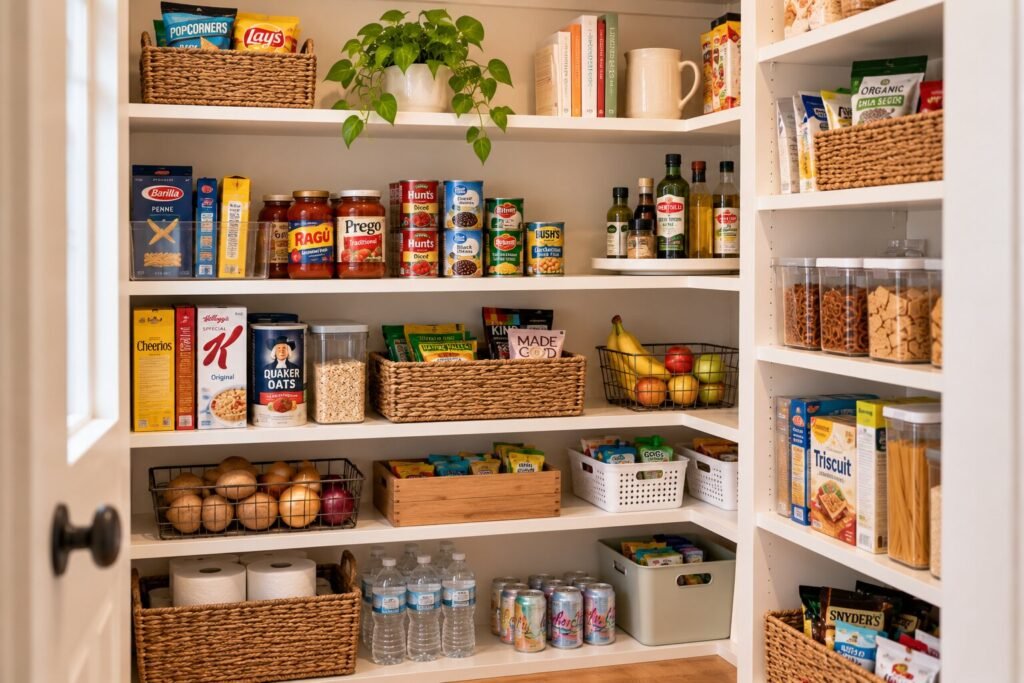
Sometimes the clutter isn’t visible until you open the pantry door.
Three open bags of the same ingredient.
A box purchased for one recipe eighteen months ago.
Duplicates hiding behind duplicates.
Almost-empty packages.
Food nobody in the house actually likes.
All of it occupies space and makes it harder to see what you do want to use.
Do a Quick Pantry Reset
You don’t need to completely reorganize the pantry every month.
Every so often, take a few minutes to look through what you have.
Check dates and the condition of older foods.
Group duplicates together.
Move open packages and foods that should be used soon somewhere visible.
Remove things that are no longer usable.
Then stop.
You don’t necessarily need to decant everything into matching containers or buy a collection of baskets.
Sometimes simply knowing what you have—and leaving a little open space—is enough.
Nook & Noted Tip: An empty spot in the pantry isn’t a problem to fill. It’s breathing room—and breathing room is part of what makes a space feel organized.
A Calmer Kitchen Usually Needs Less Clutter and Better Systems
There’s no single reason a kitchen feels cluttered.
Sometimes the answer really is letting go of things you no longer use.
Sometimes it’s moving something out of prime kitchen real estate.
And sometimes you already have exactly the right amount of stuff—it simply doesn’t have an obvious place to go.
The goal isn’t to create a kitchen with nothing on the counters and perfectly matching containers behind every cabinet door.
Your coffee maker is allowed to exist.
Your favorite mismatched mug is allowed to stay.
And nobody is coming to inspect whether your paprika lives in an aesthetically coordinated jar.
The goal is much simpler.
Make the things you use easy to find, easy to reach, and easy to put away.
And give yourself enough open space that the kitchen can actually do what it’s there to do.
The Bottom Line
A cluttered-feeling kitchen isn’t always about having too little space.
Often, it’s a handful of small habits and overlooked areas that quietly add up over time.
Don’t try to fix all ten at once.
Instead, look around your kitchen and choose the two or three problems that sound a little too familiar.
Clear the catch-all counter.
Edit the mug cabinet.
Match the food-storage lids.
Give the pantry a quick reset.
Then live with those changes for a while.
Small fixes in the places you use every day can make the entire kitchen feel noticeably calmer—without a weekend-long organizing marathon or a cart full of new storage products.
You don’t need a perfectly organized kitchen. You just need one that makes everyday life a little easier.
Looking for More Small-Space Inspiration?
Ready to make the space you have work a little harder? Explore more practical organization ideas, small-space solutions, and clever home finds from Nook & Noted.