Your entryway has a big job for such a small space: catching everything that comes in and out of your house.
Keys, shoes, mail, bags, the dog leash, a stray permission slip, someone’s second shoe that mysteriously never makes it to the first shoe’s location.
And it has to do all of that in what is often the smallest, most awkward stretch of square footage in the entire house.
The good news? You don’t need a mudroom addition or a built-in bench system to make a small entryway work. Most of the time, the fix isn’t more space—it’s a better system for the space you already have.
Here are nine practical ways to organize a small entryway, no construction required.
Before You Add Storage, Figure Out What’s Actually Piling Up
Before you buy a single hook or basket, take a minute to notice what tends to collect by your door.
Is it shoes?
Mail?
Bags that get dropped and never picked back up?
A rotating cast of one-off items that “just need a home for now” and are somehow still there three months later?
Different clutter needs different solutions, and the fastest way to choose the wrong organizer is to guess instead of look.
Once you know what’s actually landing there, it’s much easier to choose storage that solves the real problem instead of simply adding another basket to the pile.
Also consider what actually belongs in your entryway.
Every pair of shoes you own probably doesn’t need to live by the front door. Neither does every jacket, reusable shopping bag, piece of mail, or miscellaneous item that enters the house.
Nook & Noted Tip: The goal isn’t to catch everything that comes through the door. It’s to give the things that should stay there a place to go—and let everything else keep moving.
1. Create a Small Landing Zone
One of the easiest ways to make an entryway work better is to give the little things you carry in and out of the house one obvious place to land.
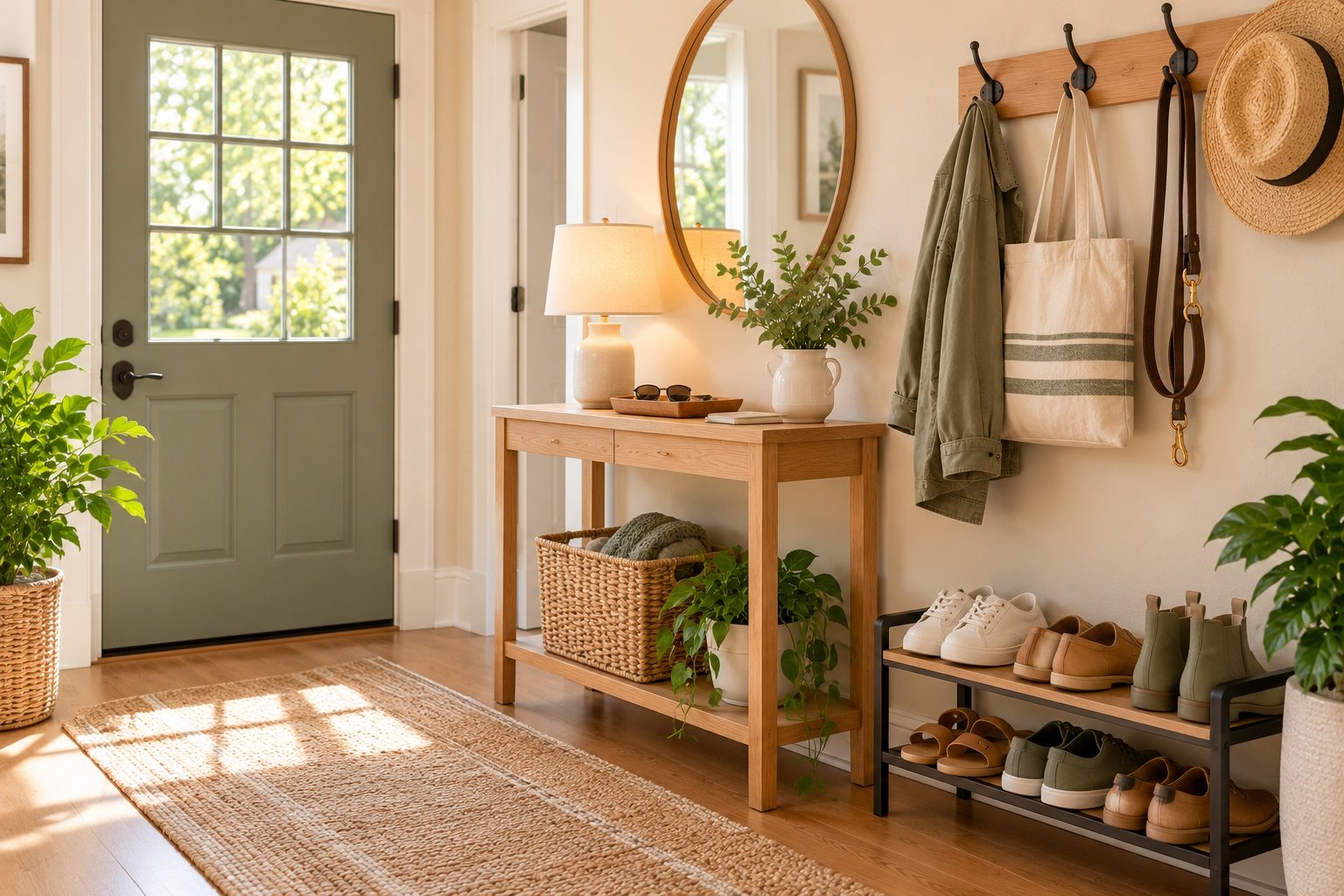
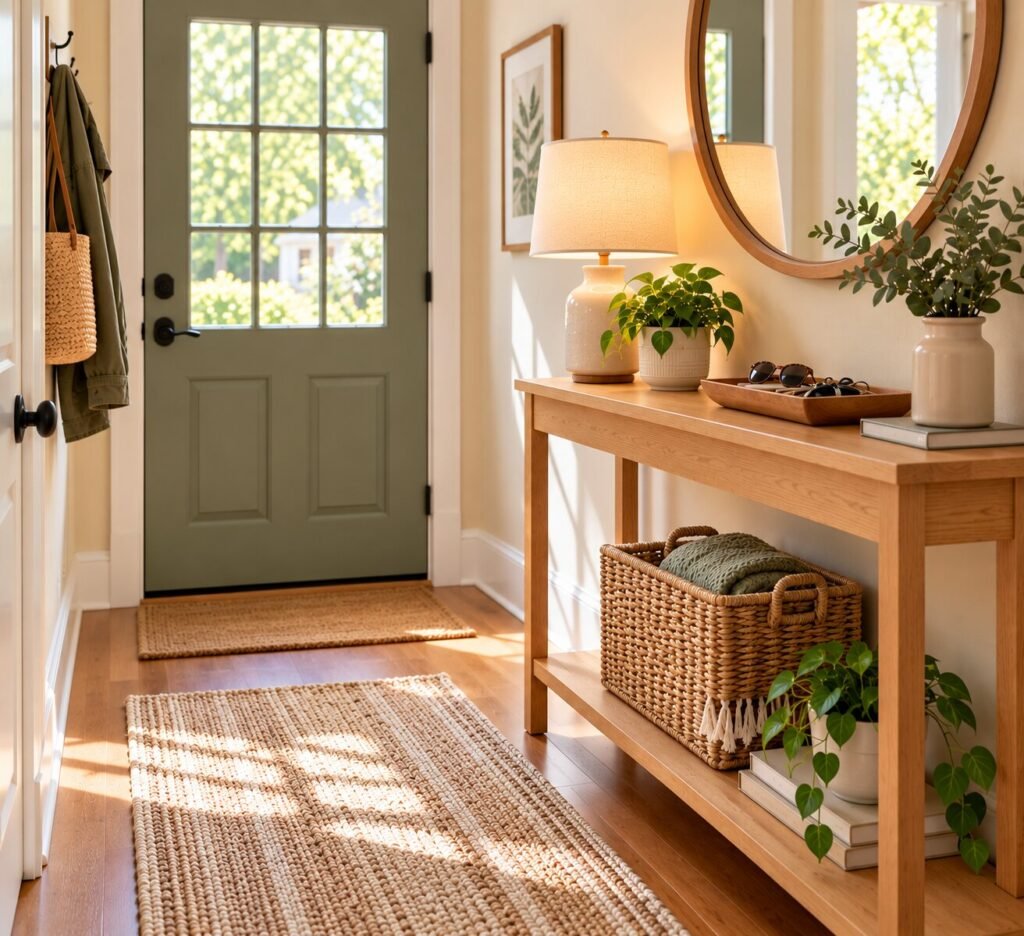
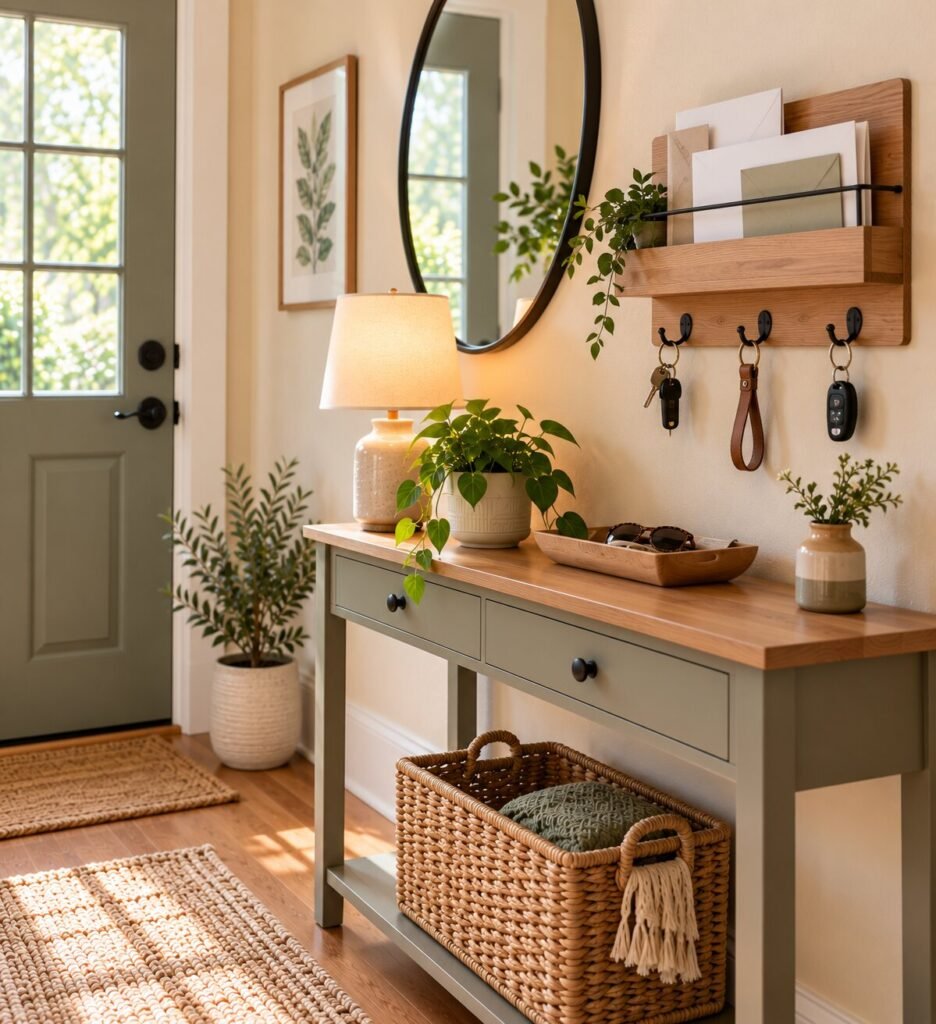
If you have enough floor space, a slim console table can create that landing zone without requiring a full-size entryway.
Keep it simple.
A console might hold:
- A small catch-all tray for keys and sunglasses
- A temporary spot for incoming mail
- A lamp or small decorative item
- One or two baskets underneath for useful storage
The key word here is temporary.
The console shouldn’t become the final destination for every piece of paper, receipt, water bottle, and mysterious object someone carries through the door.
Measure Before You Fall in Love With One
Console tables can look deceptively slim in photos.
Measure the depth and width of your available space before choosing one, and don’t forget to account for the door swing and the normal path through the entryway.
You should be able to walk through comfortably—even with grocery bags in both hands.
If you have room for storage underneath, an open shelf can add useful space without making a narrow piece of furniture feel as visually heavy.
Nook & Noted Tip: Choose the landing zone to fit the entryway—not the entryway to fit the furniture.
2. Add Hooks Before You Add Anything Else
If your entryway only gets one upgrade, hooks are a good place to start.
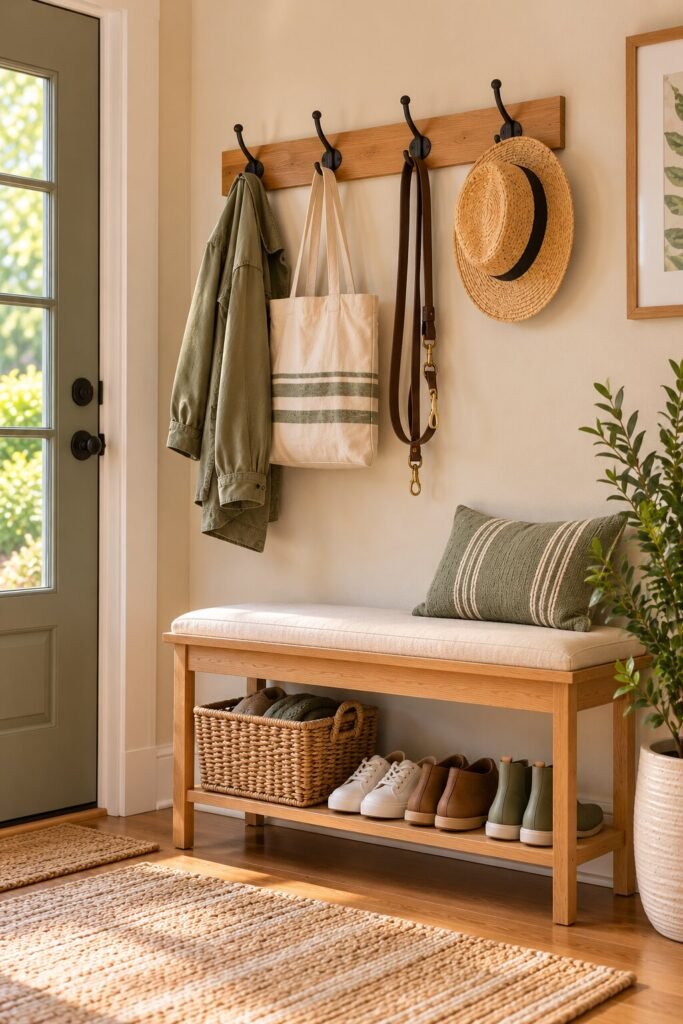
A few well-placed hooks give coats, bags, backpacks, hats, and dog leashes an obvious place to go instead of landing on a chair, stair railing, doorknob, or floor.
Hooks can work well for:
- Jackets and lightweight coats
- Tote bags and backpacks
- Dog leashes
- Hats
- Umbrellas
- Seasonal accessories
Put Them Where People Can Actually Use Them
Before installing hooks, think about who’s using the entryway.
A single row at adult height may work perfectly for adults but leave children’s backpacks and jackets right back where they started—on the floor.
If younger family members regularly use the space, a lower row may make more sense.
Also consider what will actually hang from the hooks and choose appropriately rated hardware.
A lightweight tote and a heavy winter coat don’t ask the same thing from a hook.
And don’t assume more is always better.
Nook & Noted Tip: Add enough hooks for the things that regularly belong by the door—not enough to turn the wall into long-term storage.
3. Make One Piece of Furniture Do Two Jobs
When space is limited, furniture that performs more than one function earns its keep.
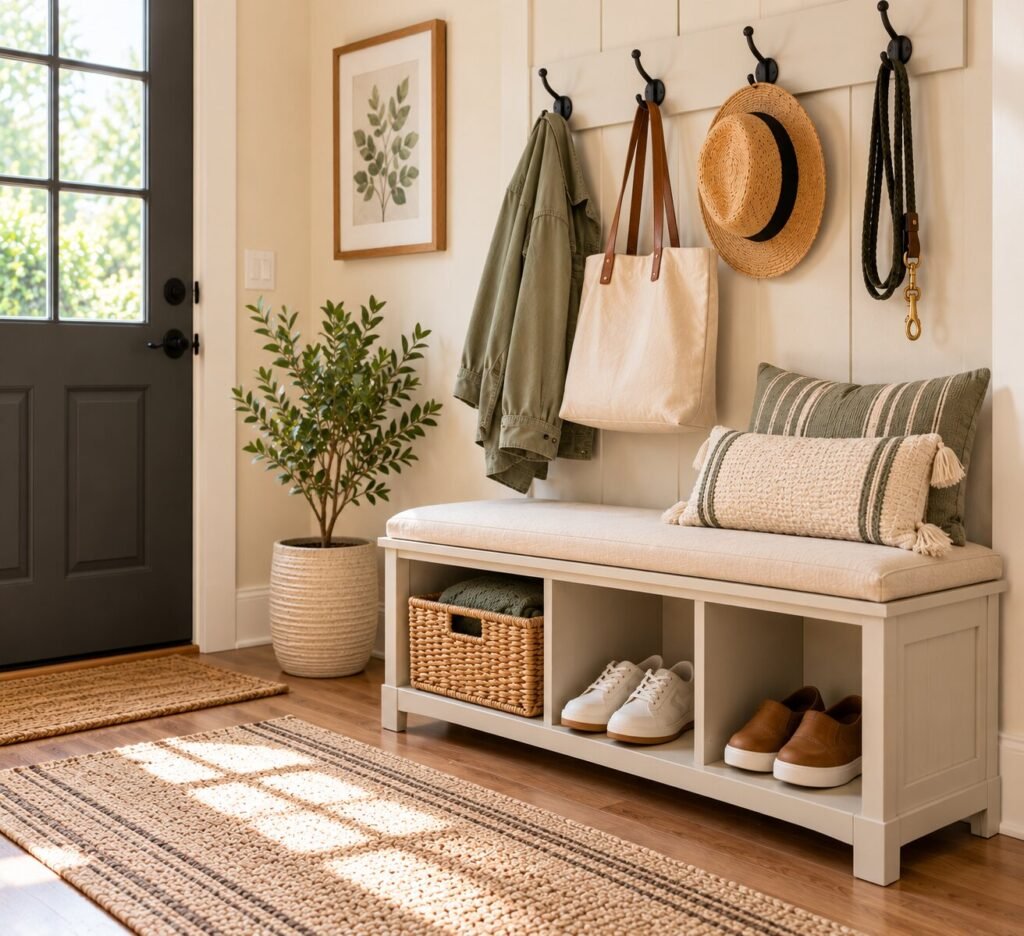
A compact storage bench can provide somewhere to sit while putting on shoes and somewhere to contain everyday entryway items.
Depending on the design, that might mean:
- Open cubbies for shoes
- Baskets underneath
- Open space beneath the seat
- Hidden storage inside
Which style works best depends on what you actually need to store.
If shoes are the biggest problem, open cubbies may be more useful than a large hidden compartment.
If you’re storing seasonal accessories, a basket or enclosed space may make more sense.
Leave Room to Walk
An oversized bench in a tiny entryway can create a new problem while solving the old one.
Before choosing one, measure the available width and depth and check the door swing.
Make sure people can still comfortably enter, leave, carry bags through the space, and open nearby doors.
Nook & Noted Tip: In a small entryway, one useful piece of furniture is often better than several smaller pieces competing for the same floor space.
4. Give Everyday Shoes a Defined Spot
Shoes are often the first thing to pile up by the door—and one of the fastest ways to make a small entryway feel cluttered.
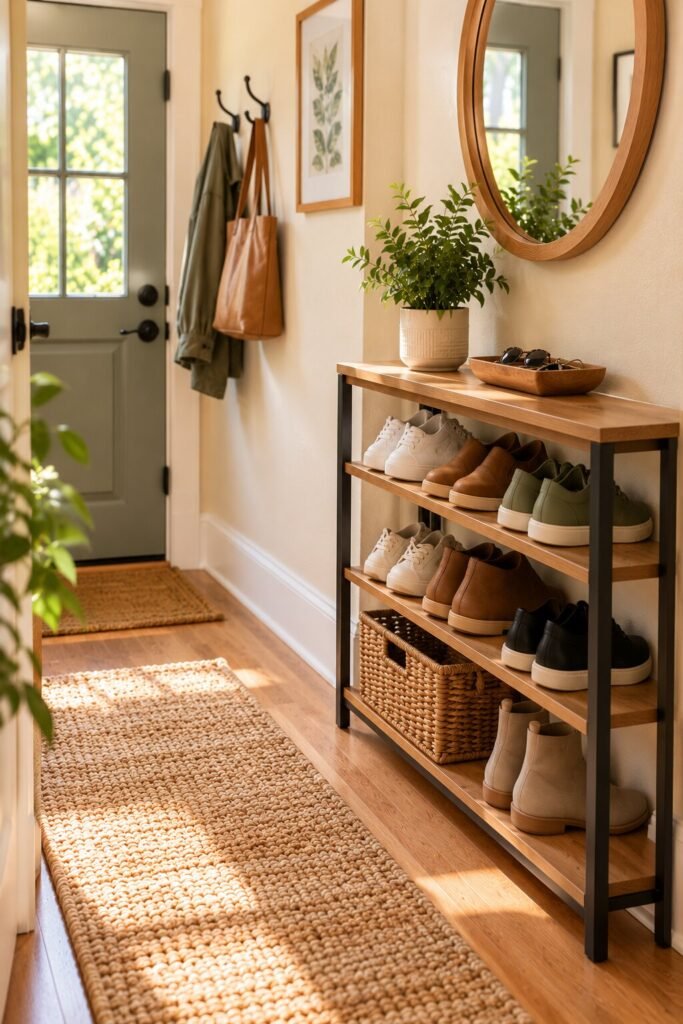
A slim shoe rack, narrow cabinet, cubbies, basket, or simple tray can give everyday pairs a defined place to go instead of letting them spread across the floor.
But here’s the important part:
Your entryway doesn’t have to store every pair of shoes your household owns.
Keep the pairs that are regularly worn near the door.
Special-occasion shoes, out-of-season footwear, and pairs you rarely reach for can live somewhere else.
That alone can make a shoe-storage system much easier to maintain.
Choose the Shape for the Space
In a narrow entryway, pay attention to the footprint of the organizer rather than simply how many pairs it claims to hold.
Measure the available depth and width and make sure shoes won’t extend into the main walking path.
The best shoe storage isn’t necessarily the one that holds the most.
It’s the one people can easily use without stepping around it every time they walk through the door.
Nook & Noted Tip: Make room for the shoes you actually wear by the door—not your entire footwear collection.
5. Stop Mail at the Door
Mail has an uncanny ability to migrate from the entryway to the kitchen counter and set up permanent residence there.
Giving incoming mail one temporary landing place can help stop that migration before it starts.
Depending on your space, that might be:
- A shallow wall-mounted mail holder
- A small tray on the console
- One designated basket
- A simple wall organizer with a mail slot and key hooks
Keep the system uncomplicated.
You probably don’t need six separate compartments for different types of mail.
You need one place where incoming mail goes—and a habit of regularly moving it from there.
Don’t Just Organize the Pile
A mail organizer works best when it’s a stopping point rather than long-term storage.
Recycle obvious junk mail quickly.
Move bills, invitations, school papers, and other action items to wherever you normally deal with them.
Otherwise, you’ve simply created a beautifully organized pile of mail.
Nook & Noted Tip: The best mail organizer isn’t the one with the most compartments. It’s the one that’s easy enough to use every day—and easy enough to empty.
6. Give Frequently Dropped Items a Basket
Some entryway items don’t fit neatly into the “coat, shoe, or key” categories.
Gloves.
Dog-walking supplies.
Sports gear.
Reusable shopping bags.
The item someone needs to remember to take to school tomorrow.
A basket can provide a useful parking spot for those odds and ends without letting them scatter across the entryway.
In a family home, that might mean one basket for each person.
In another household, it might make more sense to organize by purpose:
Cold weather: gloves, hats and scarves
Dog walks: leash, waste bags and a small towel
On the way out: library books, returns or things that need to leave the house
Choose the system that reflects what actually collects by your door.
Don’t Let the Basket Become a Junk Drawer With Handles
A basket makes clutter look tidier, but that doesn’t necessarily mean the clutter has been dealt with.
Give entryway baskets a quick reset regularly.
Move things that belong elsewhere back to their real homes and leave the basket available for the things it was meant to hold.
Nook & Noted Tip: Let the basket be the “parking spot,” not the permanent home.
7. Use the Inside of a Closet Door
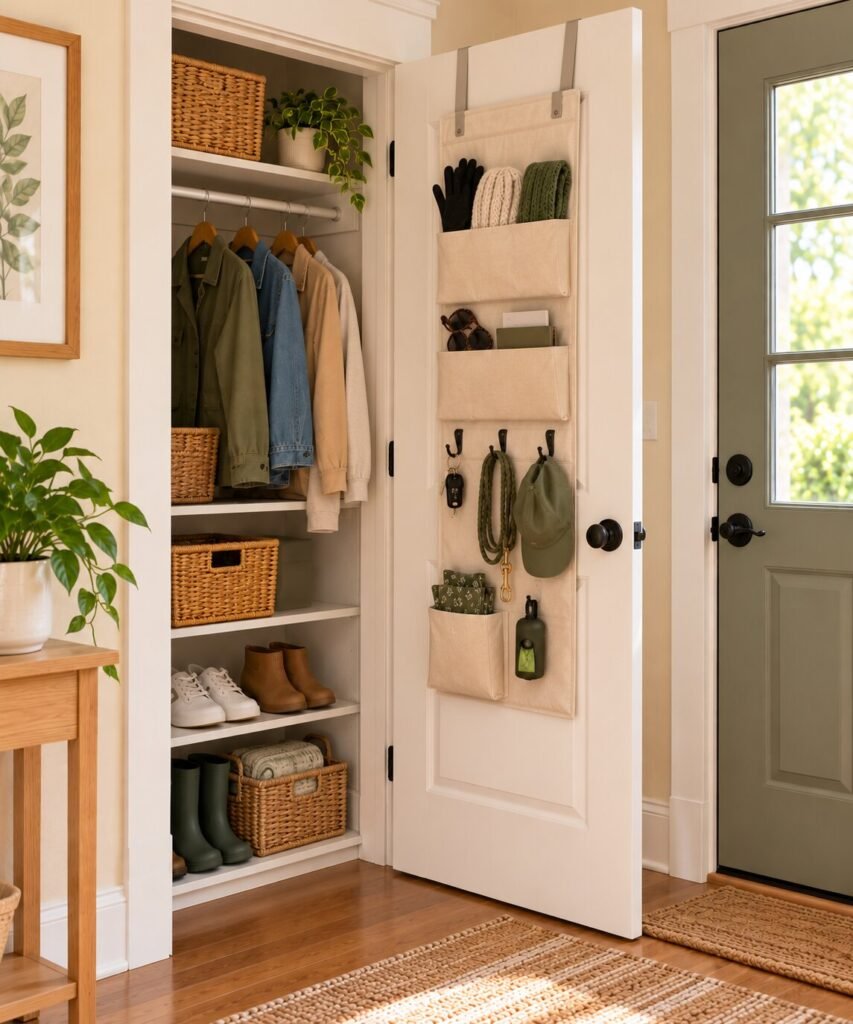
If your entryway has a closet, don’t overlook the inside of the door.
That narrow vertical surface can hold lightweight items that might otherwise take up valuable shelf space.
Depending on your setup, you might use:
- A few slim hooks
- A shallow pocket organizer
- A small rack
- An appropriate over-the-door organizer
This can work well for gloves, scarves, reusable shopping bags, dog-walking supplies, or other lightweight items.
Check the Clearance First
Before hanging anything, look at what happens when the closet door closes.
Coats, shelves, rods, and other stored items may reduce the usable depth more than you expect.
A door organizer isn’t very useful if it keeps the closet door from actually closing.
Choose something shallow enough to work with your existing closet and avoid overloading it.
Nook & Noted Tip: Closet-door storage is especially useful for lightweight things you want nearby but don’t need taking up prime shelf space.
8. Use a Small Wall Shelf When There’s No Room for a Table
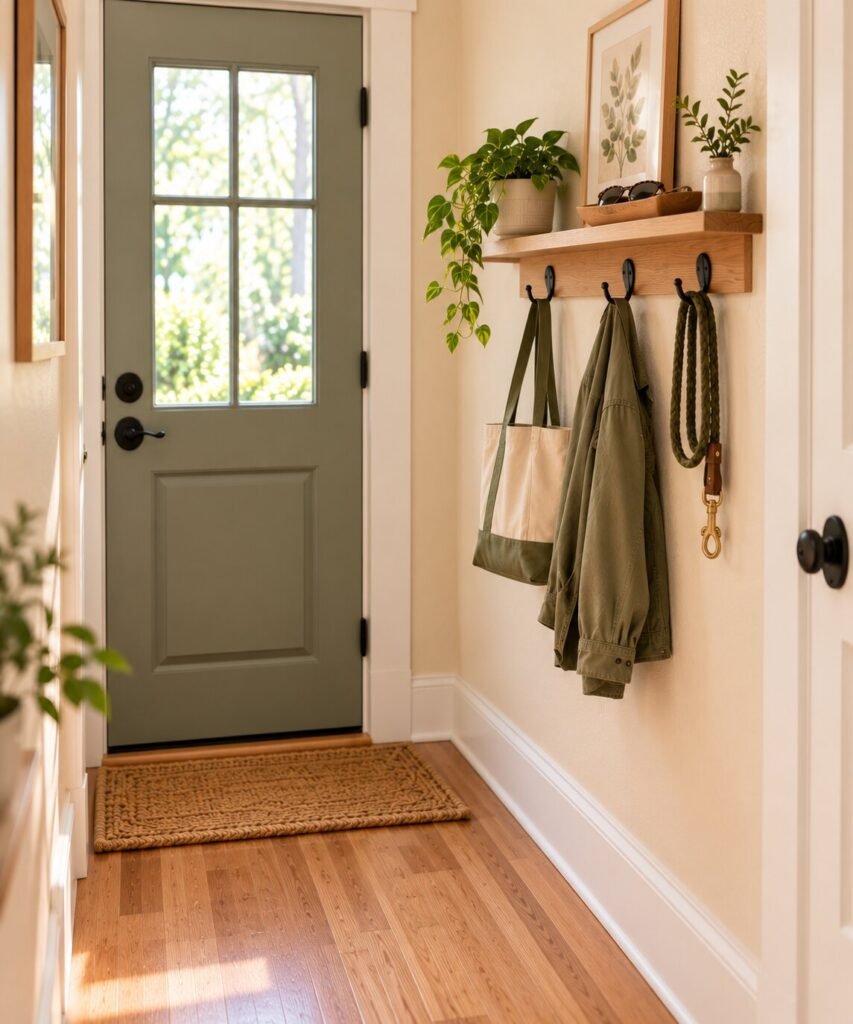
What if your entryway is too small for a console table?
Skip the table.
A shallow wall-mounted shelf can create a tiny landing zone for keys, sunglasses, or a wallet while keeping the floor completely open.
Add a few hooks underneath and you’ve created useful entryway storage in a surprisingly small amount of space.
This can work particularly well:
- Beside the front door
- On a short stretch of hallway wall
- Near an apartment entrance
- In a narrow entry where furniture would interfere with the walkway
Keep It Shallow
The goal is to create a landing spot—not install a countertop in the hallway.
Choose a shelf depth that works with the available walking space and doesn’t interfere with the door.
And resist the urge to fill the wall simply because you’ve discovered vertical storage.
A small shelf, a few hooks, and some open space may be all you need.
Nook & Noted Tip: When floor space is scarce, think about what the wall can do before adding another piece of furniture.
9. Contain Whatever Comes In on Your Shoes
Rain, mud, sand, grass, dirt—shoes have a way of bringing a little bit of the outdoors inside with them.
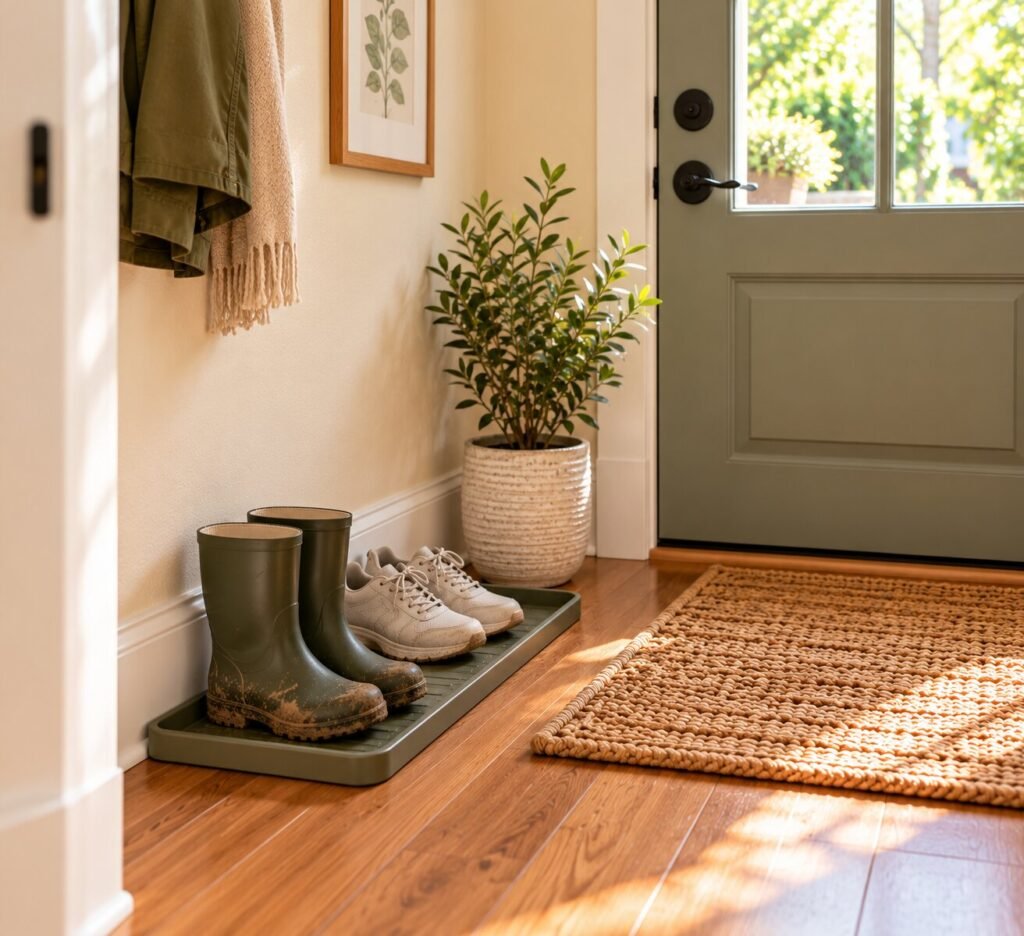
A simple boot tray or washable mat can help contain the mess near the door rather than letting it travel across the floor.
This doesn’t need to become another elaborate entryway system.
Sometimes one easy-to-clean surface is enough.
Keep It Out of the Walking Path
Place the tray or mat close enough to the door that people will actually use it, but not directly where everyone has to step around it.
If you choose a tray, slightly raised edges can help contain moisture and debris.
And keep the number of shoes reasonable.
A boot tray with two or three wet pairs is useful.
A boot tray buried beneath twelve pairs of shoes is simply a shoe pile with boundaries.
Nook & Noted Tip: The easiest mess to clean is the one that never makes it past the door.
A Small Entryway Doesn’t Need Storage Everywhere
When space is tight, it’s tempting to treat every empty wall, corner, and surface as another storage opportunity.
But a well-organized entryway isn’t about filling every available inch.
It’s about matching the storage to what actually lands there.
A bench with a little open room is easier to use.
A shelf that isn’t packed edge to edge is easier to keep tidy.
And an entryway with some visible breathing room can feel calmer the moment you walk through the door.
You don’t need hooks on every wall, baskets under every surface, and a labeled container devoted to each member of the household’s sunglasses.
A little empty space is useful too.
The goal isn’t to maximize every surface.
It’s to give the things that belong in the entryway an obvious, easy place to go.
The Bottom Line
A small entryway doesn’t need a renovation to work better.
It needs a simple system that matches how your household actually comes and goes.
Start by noticing what tends to pile up.
If coats and bags are the problem, begin with hooks.
If shoes are taking over the floor, give everyday pairs a defined spot.
If keys and mail keep migrating through the house, create one small landing zone.
Then live with those changes for a while before adding something else.
You may discover that your entryway doesn’t need five new organizers.
It just needed one or two solutions in the right places.
You don’t need to organize every inch.
You just need those few feet by the door to make coming home—and heading out—a little easier.
Looking for More Small-Space Inspiration?
Ready to make the space you have work a little harder? Explore more practical organization ideas, small-space solutions, and clever home finds from Nook & Noted.