
You don’t need a full home overhaul to make your space feel more organized.
Sometimes a few small, well-chosen solutions can make everyday things much easier to put away. A basket gives wandering blankets a home. A tray keeps keys and sunglasses from spreading across the counter. A few drawer organizers can turn one frustrating drawer into a space that actually works.
The goal isn’t to buy more stuff in the name of organization. It’s to choose simple tools that make the things you already own easier to store, find, and put away.
Here are seven simple finds that can make a surprisingly big difference.
Before You Buy Another Organizer
Organization products only help when they solve a specific problem.
Before buying another bin, basket, cart, or tray, ask yourself two questions:
What exactly will I store in it?
Where exactly will it go?
If you can’t answer both questions, don’t buy it yet.
It’s surprisingly easy to see an attractive organizer, bring it home, and then start searching for something to put inside it.
That’s backwards.
Start with the problem. Then choose the product that solves it.
Before you shop, declutter the area you’re trying to organize and measure the available space. A beautiful storage basket that’s two inches too wide isn’t an organization solution—it’s something else you now have to find a place for.
Nook & Noted Tip: Keep the measurements in your phone. A quick photo of the space can also be surprisingly helpful when you’re comparing different sizes and shapes.
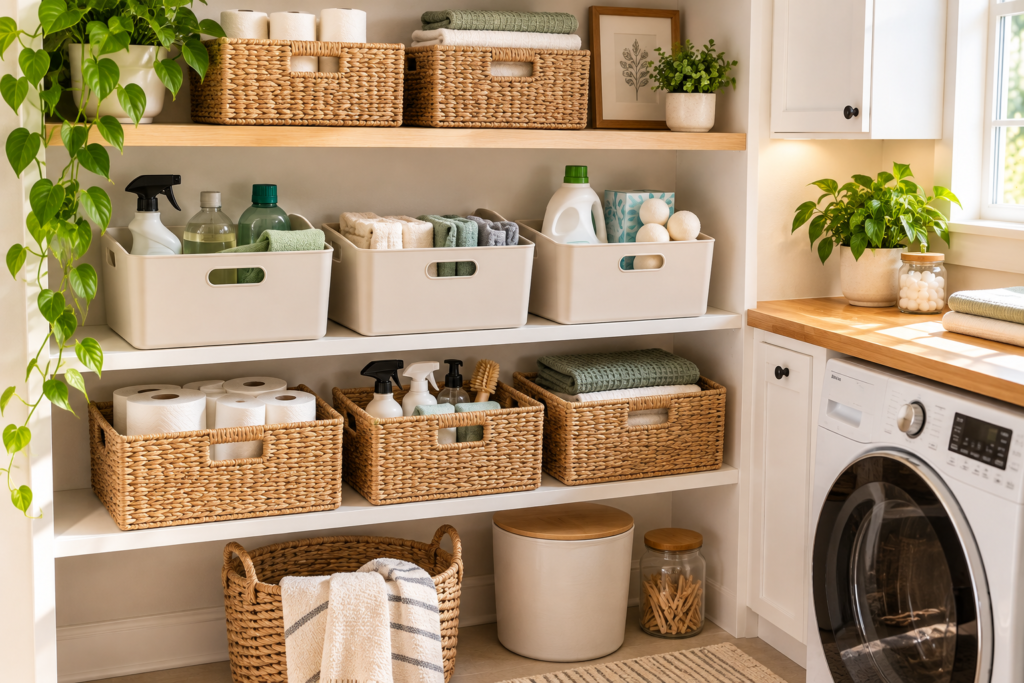
1. Give Small Items a Home With Open-Top Bins
Open shelves can quickly start to look cluttered when they’re filled with lots of small individual items.
Open-top storage bins provide a simple solution by grouping related things together and giving each category a clearly defined home.
Instead of one laundry-room shelf filled with individual bottles, cloths, brushes, and supplies, for example, you might create one bin for everyday cleaning supplies and another for extras.
The same idea works throughout the house:
- Bathroom: Hair products, extra toiletries and washcloths
- Closet: Accessories, scarves and seasonal items
- Playroom: Blocks, art supplies and small toys
- Office: Cables, notebooks and mailing supplies
- Laundry room: Stain removers, dryer supplies and cleaning cloths
The real benefit isn’t that everything is hidden inside a pretty container.
It’s that everyone knows where those things belong when it’s time to put them away.
Choose the Bin for the Space
Clear bins are useful when you need to see what’s inside. Decorative baskets may make more sense on open shelving where the containers are part of the room.
Lightweight bins with handles can be helpful on higher shelves, while open-top designs are often easier to maintain because you don’t have to remove a lid every time you put something away.
If the bins will be visible, choosing a similar style can also help the space feel calmer and more cohesive.
But don’t buy a giant matching set before you know how many bins you actually need.
Organize one area first. Live with the system for a while. Then add more if it’s working.
2. Give the Junk Drawer Some Boundaries
Pens. Tape. Batteries. Scissors. Spare keys. Takeout menus.
And probably three mystery objects nobody remembers buying.
You don’t necessarily have to eliminate the junk drawer.
You just need to give the junk some boundaries.
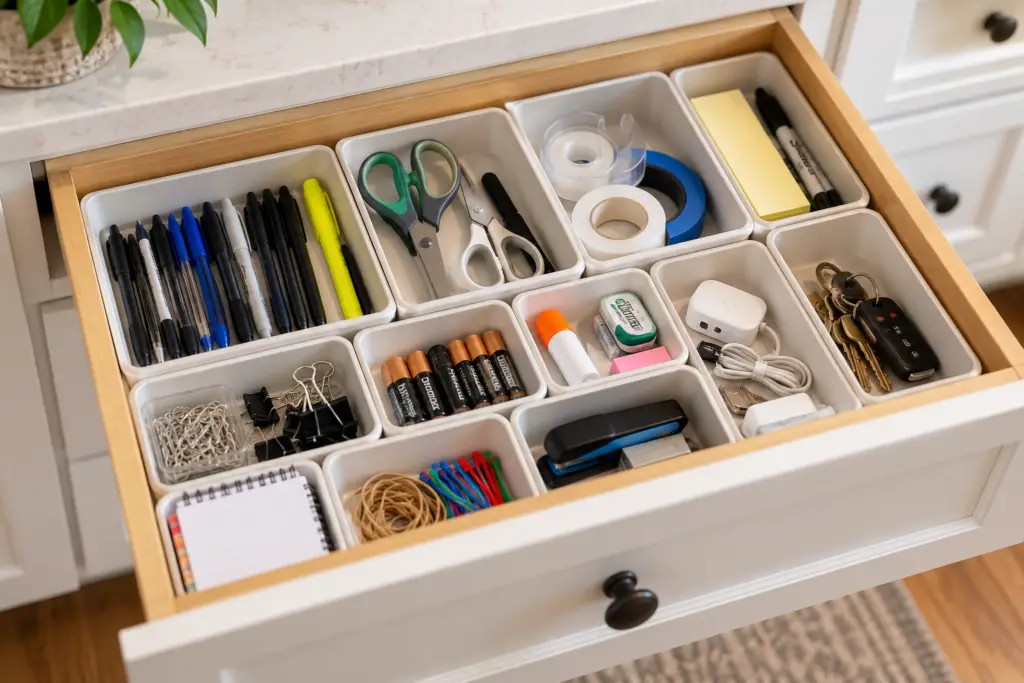
Modular drawer organizers divide one large open drawer into smaller zones, preventing everything from sliding back into one giant pile every time the drawer opens.
Use one compartment for pens and pencils, another for tape and scissors, another for batteries, and another for those miscellaneous little items you actually use.
Organize the Contents Before the Drawer
Before choosing organizers, empty the entire drawer.
Get rid of obvious trash and anything that belongs somewhere else. Then group what’s left into categories.
Once you can see what actually needs to go back into the drawer, you’ll have a much better idea of the compartment sizes you need.
Modular trays can be especially useful because you can rearrange them as the contents of the drawer change.
Measure the drawer’s interior width, depth, and height before you shop.
And leave a little open space.
If every compartment is packed on day one, the drawer has nowhere to absorb the occasional new item.
Nook & Noted Tip: The goal isn’t to create a picture-perfect drawer. It’s to be able to open it and find the scissors without digging underneath six other things.
3. Reduce Closet Visual Clutter With Consistent Hangers
Sometimes a closet can be technically organized and still look surprisingly cluttered.
One reason may be the hangers.
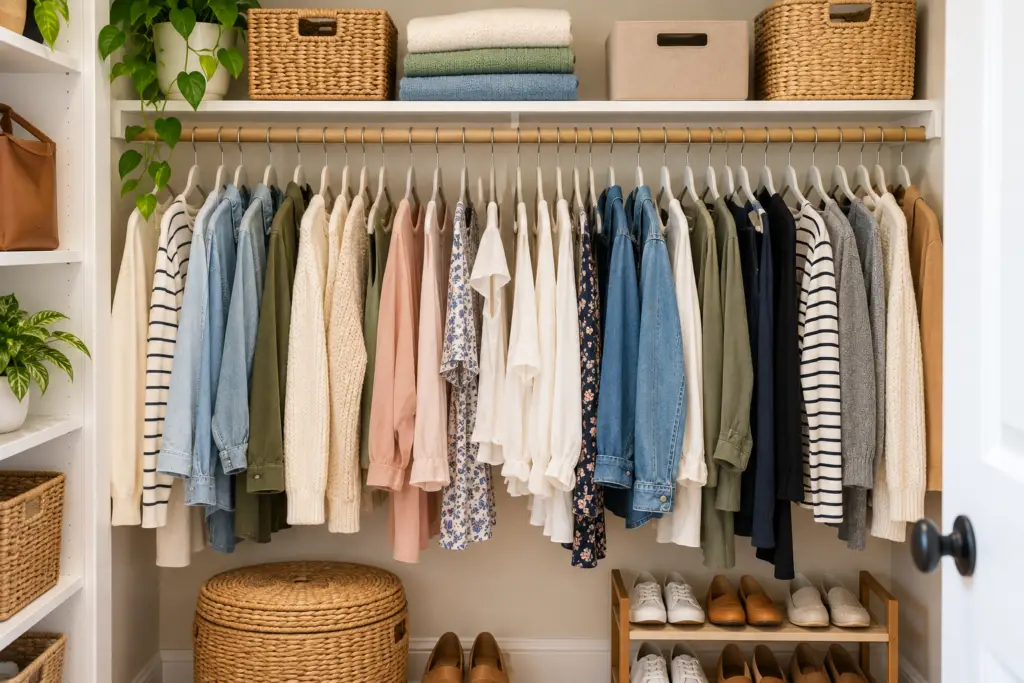
A mixture of wire, wood, plastic, padded, and store hangers creates different heights, shapes, and colors throughout the closet.
Reducing the number of different hanger styles can instantly make the space feel calmer.
They don’t necessarily need to be identical.
Even gradually switching toward one or two consistent styles can make the clothing itself become the focus rather than the hangers.
Slim-profile hangers may also take up less room than bulkier designs, potentially giving your clothes a little more breathing room.
Choose Hangers for Your Clothes, Not Just Your Closet
The prettiest hanger isn’t necessarily the most useful one.
Non-slip surfaces can be helpful for shirts, blouses, and dresses that tend to slide off. Heavier coats and jackets may need something sturdier.
And there’s no reason to replace every hanger overnight.
Start with the clothes you actually wear and gradually replace mismatched hangers as needed.
Nook & Noted Tip: Declutter the closet before buying a huge set of new hangers. There’s no point buying a beautiful new hanger for a shirt you haven’t worn in four years.
4. Give Everyday Essentials a Landing Spot
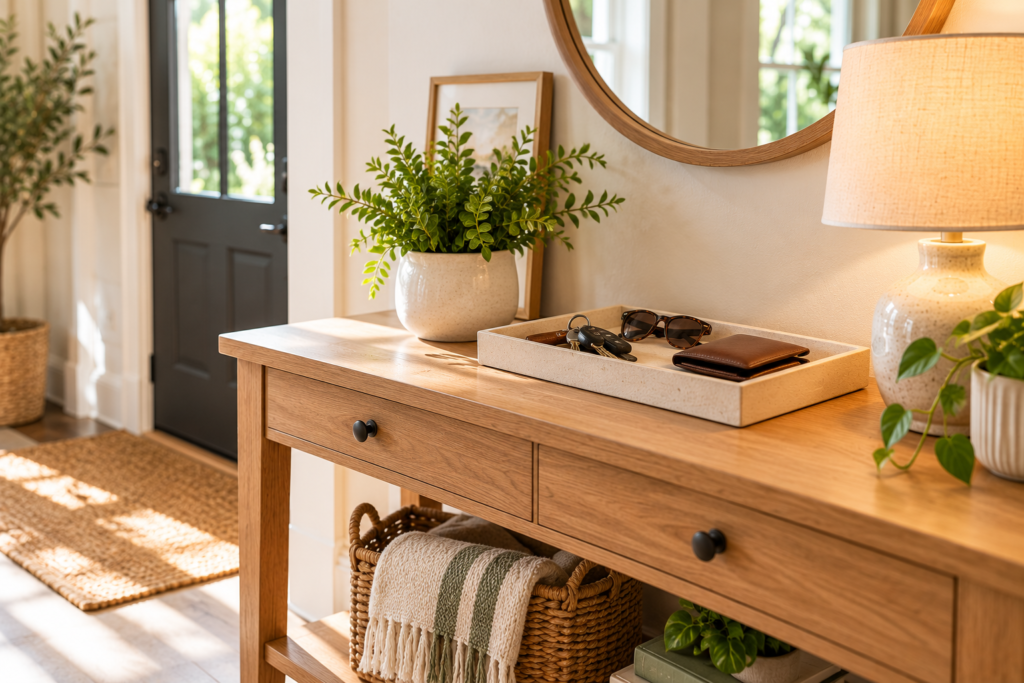
Keys. Sunglasses. Wallets. Earbuds. Watches. Loose change.
Small everyday items have a habit of slowly spreading across counters, dressers, and tables.
Instead of constantly moving them from one place to another, give them somewhere obvious to land.
A small catch-all tray near the front door can hold keys and sunglasses.
One on a dresser might hold jewelry and a watch.
A small tray on a nightstand can collect earbuds and the handful of little things you regularly use before bed.
The goal isn’t to hide everything.
It’s simply to give frequently used items a predictable place to go.
Follow the Clutter
Keep the tray fairly small.
A huge catch-all tray eventually becomes a very shallow junk drawer.
Choose something large enough for the handful of items that regularly accumulate in that particular spot—and no larger.
Most importantly, put the tray where the clutter already happens.
If everyone naturally drops their keys on the entryway console, that’s where the tray belongs.
Don’t put it across the room simply because you think it looks better there.
Good organization follows real habits.
5. Make It Easy to Put Blankets Away
Throw blankets are useful, comfortable, and great at making a room feel cozy.
Right up until six of them are piled on one end of the couch.
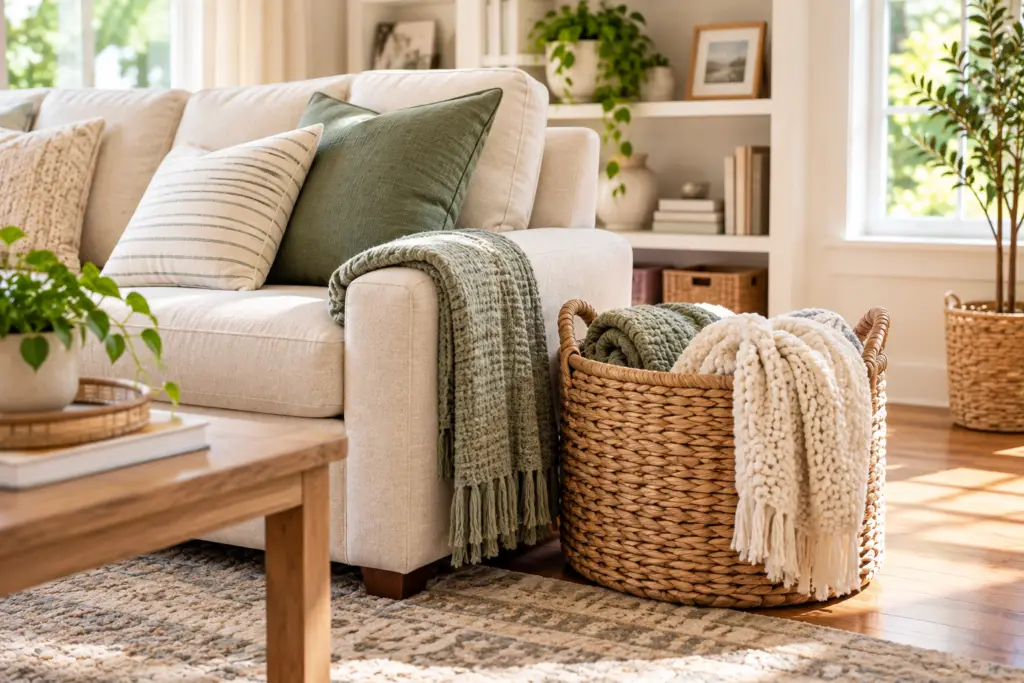
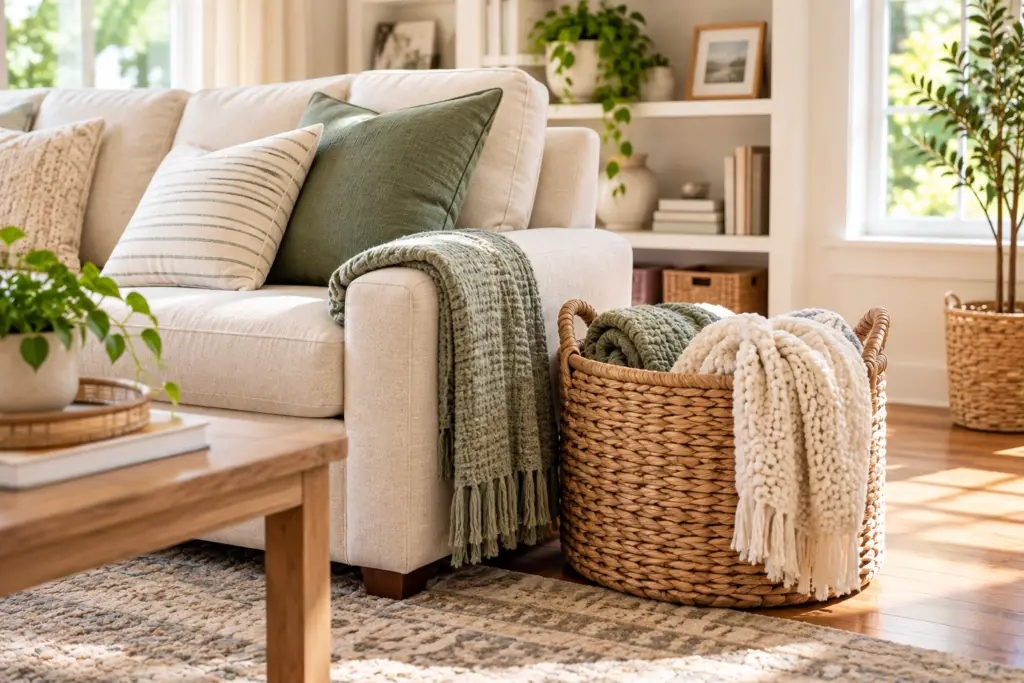
A generously sized floor basket creates an obvious place for blankets without requiring anyone to fold each one perfectly or carry it to a linen closet every time they’re finished using it.
Place the basket beside a sofa, next to a reading chair, or in a bedroom—wherever the blankets are actually used.
One of the simplest secrets to maintaining an organized home is this:
Make putting something away almost as easy as leaving it out.
That’s exactly what a blanket basket does.
Bigger Isn’t Always Better
Choose a basket large enough for the number of throws you regularly use, but don’t automatically buy the largest one you can find.
Soft-sided woven or fabric baskets can be easy to move and may be less likely to scratch nearby furniture or flooring. Handles are also useful if you’ll move the basket when vacuuming or cleaning.
And if your basket is permanently overflowing, you may not need a bigger basket.
You may simply have more blankets in the room than you regularly use.
6. Create One Home for Everyday Devices
Phones and tablets have a way of appearing everywhere.
One phone is charging on the kitchen counter. Another cable is hanging beside the sofa. A tablet is sitting on a nightstand. Someone has borrowed the charger you thought was in the bedroom.
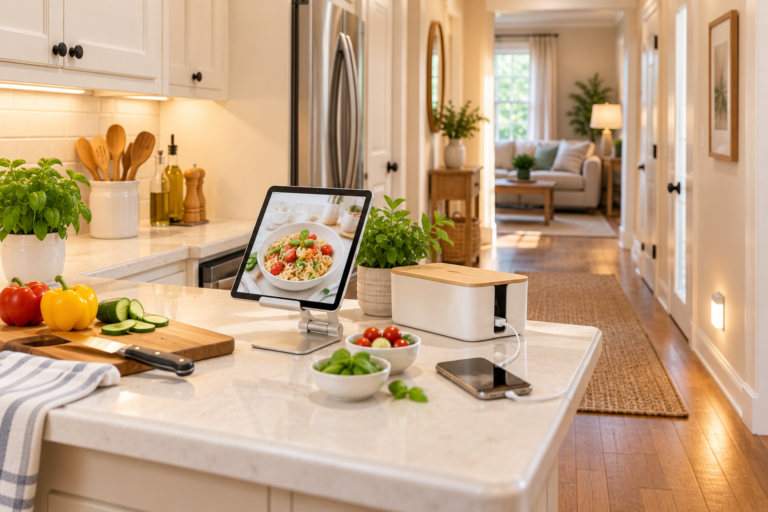
Creating one convenient landing spot for frequently used devices can help contain some of that everyday electronics clutter.
Instead of everyone plugging compatible devices into whichever outlet happens to be available, designate one convenient place where devices can land and charge.
A simple charging station or organized device tray can work especially well in a household with several devices because it gives both the electronics and their related cables a predictable home.
It may even help answer that familiar question:
“Where did I leave my phone?”
Put It Where Devices Already Gather
Don’t create a charging station in the place where you wish everyone would leave their devices.
Pay attention to where phones and tablets already tend to accumulate.
That may be a kitchen counter, home-office area, entryway, or family command center.
Choose a setup that provides enough room for the devices your household actually uses and allows compatible charging cords to be routed neatly.
If the setup includes electrical components or charging hardware, choose appropriately certified products from reputable manufacturers and follow the manufacturer’s usage and ventilation instructions.
Nook & Noted Tip: A charging station doesn’t need to accommodate every electronic device you own. Focus on the devices that regularly create clutter in shared spaces.
7. Give a Rolling Cart One Job
Rolling storage carts are popular for a reason.
They provide several levels of storage without requiring permanent shelving, and they can move wherever they’re needed.
But there’s one rule that can make the difference between a useful rolling cart and a three-tier mobile junk drawer:
Give the cart one job.
For example:
- Craft supplies
- Homework supplies
- Bathroom essentials
- Cleaning supplies
- Coffee station
Once you’ve defined the cart’s purpose, deciding what belongs on it becomes much easier.
A craft cart can roll to the table when someone wants to work on a project and move out of the way afterward.
A cleaning cart can keep related supplies together and move from one area to another.
A coffee cart can create a small beverage station without permanently taking over the kitchen counter.
Measure the Whole Cart
Before buying one, check the overall dimensions—not just the size of the shelves.
Make sure it will fit wherever you plan to store it, including the wheels and handles.
Also consider weight capacity and wheel quality, particularly if you’ll move the cart regularly. Locking wheels can be useful if the cart needs to remain stationary while you’re using it.
Nook & Noted Tip: Don’t buy a rolling cart until you can finish this sentence: “This cart is going to hold ______.”
If you don’t know the answer yet, you probably don’t need the cart yet.
Before You Buy, Try This First
A home doesn’t feel organized simply because everything has been placed inside a basket.
Sometimes the solution really is a bin.
Sometimes it’s a drawer divider.
And sometimes it’s realizing you don’t need six versions of the thing you’re trying to organize.
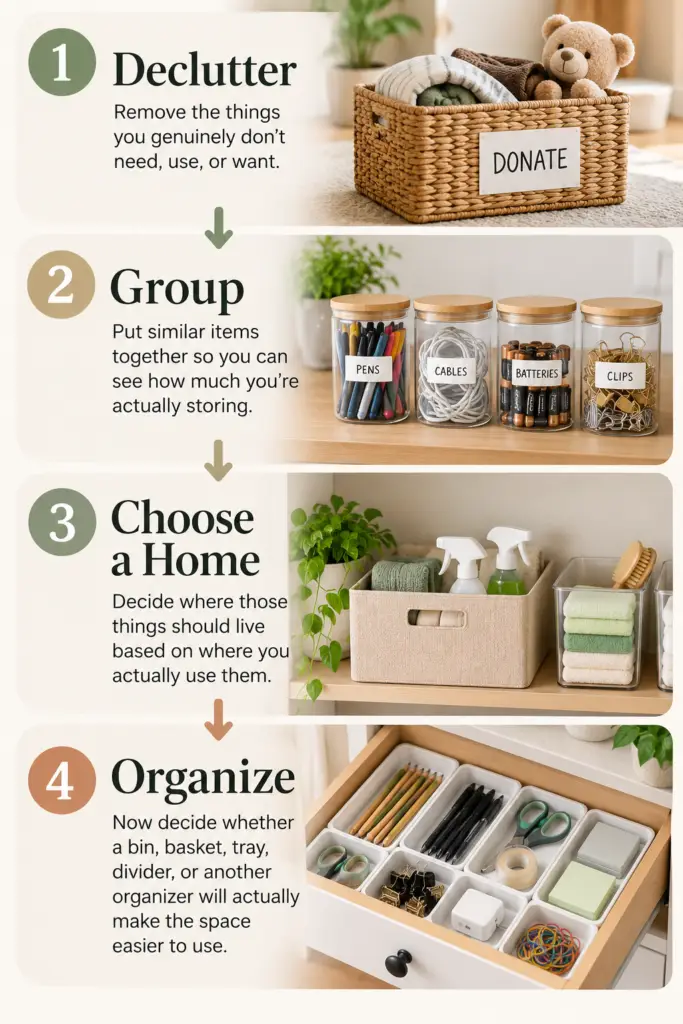
Before buying another organizer, try these four steps.
1. Declutter
Remove the things you genuinely don’t need, use, or want.
There’s no reason to spend money organizing something you would be happier without.
2. Group
Put similar items together.
This allows you to see how much you’re actually storing and whether those items naturally belong together.
3. Choose a Home
Decide where those things should live based on where you actually use them.
The most attractive storage location isn’t necessarily the most practical one.
4. Organize
Now decide whether a bin, basket, tray, divider, cart, or another organizer would actually make that space easier to use.
You may discover you need something much smaller than you originally expected.
Or nothing at all.
Nook & Noted Tip: Think of an organizer as the final step—not the starting point.
The Bottom Line
A more organized home usually comes from a combination of fewer unnecessary things, less visual clutter, and simple systems that make everyday items easy to put away.
You don’t need all seven products on this list.
Start with the place in your home that frustrates you most.
If it’s the junk drawer, add a few modular trays.
If blankets are always covering the sofa, give them an easy-to-reach basket.
If everyone’s devices keep appearing on different counters, create one convenient place for them to land.
Solve one real problem first.
Then live with the solution for a while before moving on to the next.
Because the best organization products don’t just make your home look tidier.
They make keeping it that way a little easier.
Looking for More Home Organization Inspiration?
Ready to make your home work a little better? Explore more practical organization ideas, small-space solutions, and clever home finds from Nook & Noted.